
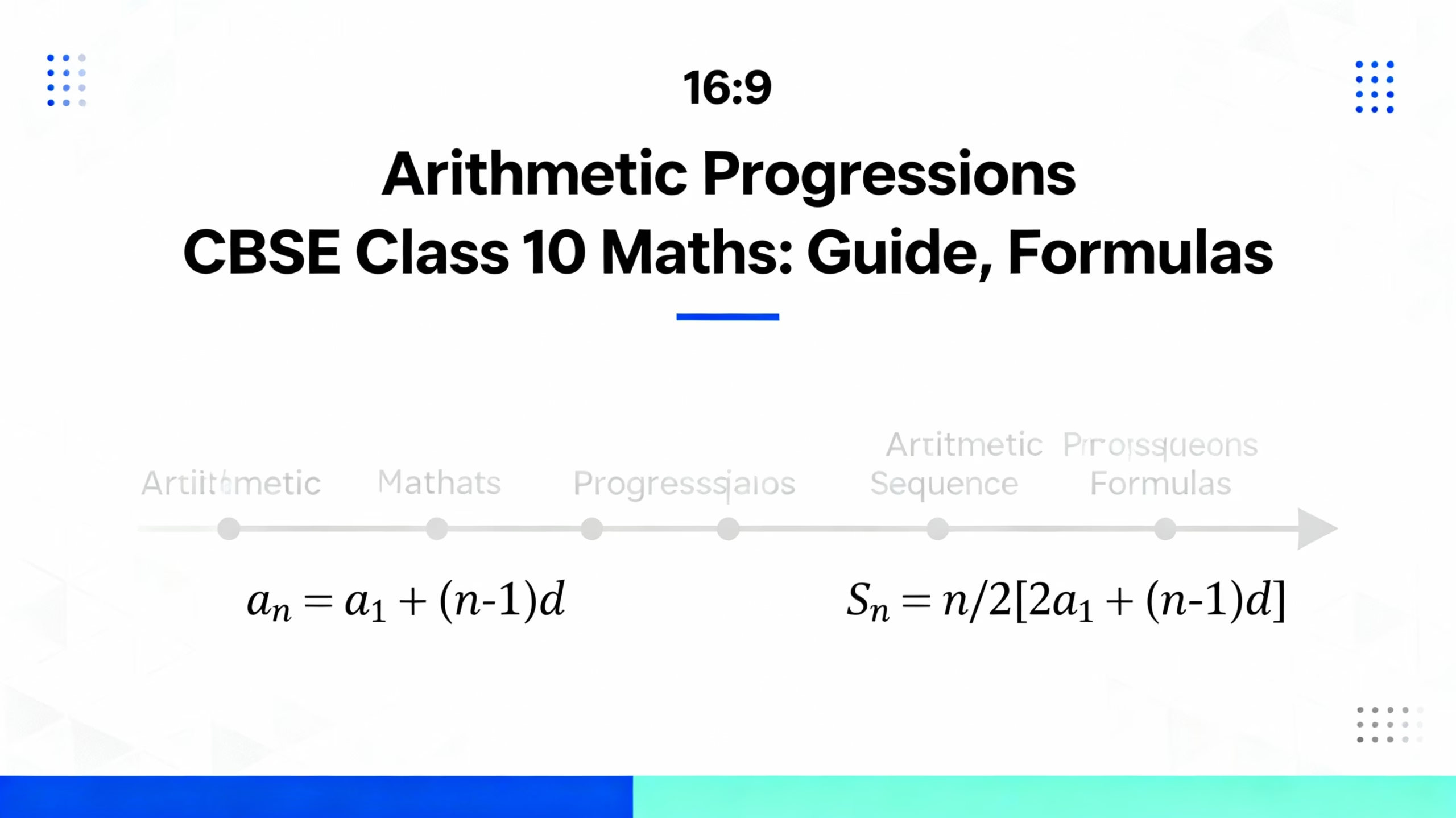
Arithmetic Progressions CBSE Class 10 Maths: Guide, Formulas
This complete guide to Arithmetic Progressions (AP) for CBSE Class 10 Maths breaks down every concept. Understand the nth term, sum of n terms, and common difference. Practice with solved Q&A, explore real-world case studies, and use our unique interactive AP visualizer and concept mind map to master the chapter.
Guide to Arithmetic Progressions
Your complete guide to Class 10 Arithmetic Progressions. Understand concepts, practice problems, and visualize patterns.
Core Concepts
What is an Arithmetic Progression?
An Arithmetic Progression (AP) is a list of numbers. Each number in the list is found by adding a fixed number to the term before it.
This fixed number is called the common difference, or ‘d’. The common difference can be positive, negative, or zero.
- Example 1 (d > 0): 2, 5, 8, 11… (Here, d = 3)
- Example 2 (d < 0): 100, 90, 80, 70… (Here, d = -10)
- Example 3 (d = 0): 7, 7, 7, 7… (Here, d = 0)
Finding the Common Difference (d)
To find ‘d’, subtract any term from the term that comes right after it.
d = (Term 2) – (Term 1)
d = (Term 3) – (Term 2)
d = ak+1 – ak
In an AP, this value will always be the same.
The General Term (an)
The ‘general term’ formula lets you find any term in the sequence without writing out the whole list. We use an to stand for the ‘nth’ term.
an = a + (n-1)d
- an: The term you want to find.
- a: The first term of the sequence.
- n: The position of the term (e.g., 5th, 10th).
- d: The common difference.
The Sum of Terms (Sn)
This formula helps you find the sum of the first ‘n’ terms of an AP. There are two formulas you can use.
Formula 1: (When ‘d’ is known)
Sn = (n/2) * [2a + (n-1)d]
Formula 2: (When last term ‘l’ is known)
Sn = (n/2) * (a + l)
Here, ‘l’ is the last term, which is the same as an.
Real-World Patterns
Example: Annual Salary
Imagine a job with a starting salary of 80,000 and a fixed annual raise of 5,000.
The salary for the 1st, 2nd, 3rd, and 4th years would be:
- Year 1: 80,000
- Year 2: 85,000
- Year 3: 90,000
- Year 4: 95,000
This is an AP with a = 80000 and d = 5000.
Example: Ladder Rungs
Consider a ladder where the rungs decrease in length by 2 cm from bottom to top. The bottom rung is 45 cm.
The lengths of the rungs from the bottom are:
- Rung 1: 45 cm
- Rung 2: 43 cm
- Rung 3: 41 cm
- Rung 4: 39 cm
This is an AP with a = 45 and d = -2.
What an AP is Not: A Comparison
Not all patterns are Arithmetic Progressions. An AP must have a common difference (adding/subtracting). If a pattern grows by a common ratio (multiplying/dividing), it is a Geometric Progression (GP).
This IS an AP (Additive)
Scenario: Salary with a fixed annual raise of 500.
- Year 1: 8,000
- Year 2: 8,500 (+500)
- Year 3: 9,000 (+500)
- Year 4: 9,500 (+500)
The difference is constant. d = 500.
This is NOT an AP (Multiplicative)
Scenario: A savings amount becomes 5/4 times itself every 3 years. Start with 8,000.
- Start: 8,000
- After 3 Yrs: 10,000 (x 1.25)
- After 6 Yrs: 12,500 (x 1.25)
- After 9 Yrs: 15,625 (x 1.25)
The difference is not constant (2000, 2500, …). It is multiplied by 1.25 each time. This is a Geometric Progression.
AP Visualizer (Drawing)
Enter the AP details below to see how it looks on a chart. This ‘drawing’ shows the value of each term.
Formula Table
| Concept | Formula |
|---|---|
| General Term | an = a + (n-1)d |
| Sum (d known) | Sn = (n/2)[2a + (n-1)d] |
| Sum (l known) | Sn = (n/2)(a + l) |
| Term from Sum | an = Sn – Sn-1 |
| Arithmetic Mean | b = (a+c) / 2 |
Practice Q&A
Question 1: Find the 10th term of the AP: 2, 7, 12, …
Question 2: How many two-digit numbers are divisible by 3?
Question 3: Find the sum of the first 22 terms of the AP: 8, 3, -2, …
Application Case Study: Word Problems
Problem: A Savings Plan
A person saves 100 in the first month, 150 in the second month, 200 in the third month, and so on.
Question: What is the total amount saved after 2 years (24 months)?
Step 1: Identify if it is an AP
The savings are: 100, 150, 200, …
The difference (150 – 100) is 50.
The difference (200 – 150) is 50.
Since the common difference is fixed, this is an AP.
Step 2: Define the variables
From the problem, we can find the key values:
- First Term (a): The saving in the first month is 100. So, a = 100.
- Common Difference (d): The saving increases by 50 each month. So, d = 50.
- Number of Terms (n): We want the total after 2 years, which is 24 months. So, n = 24.
Step 3: Choose the correct formula
The question asks for the “total amount”, which means we need to find the Sum. We know a, d, and n.
We will use the sum formula: Sn = (n/2) * [2a + (n-1)d]
Step 4: Solve the problem
S24 = (24 / 2) * [2(100) + (24 – 1)(50)]
S24 = 12 * [200 + (23)(50)]
S24 = 12 * [200 + 1150]
S24 = 12 * [1350]
S24 = 16200
Conclusion
The total amount saved after 2 years is 16,200.
Challenge Problem: Terrace Volume
Problem: A Concrete Terrace
A terrace is built of 15 steps. Each step has a rise of 1/4 m and a tread of 1/2 m. Each step is 50 m long. (See Fig. 5.8 from the text).
Question: Find the total volume of concrete required to build the terrace.
Step 1: Understand the problem
The total volume is the sum of the volumes of all 15 steps. Let’s find the volume of each step.
The volume of a cuboid (like a step) is Length x Width x Height.
Here, the “Width” is the tread (1/2 m) and “Height” is the rise (1/4 m). The “Length” is 50 m.
However, the 2nd step’s volume is not just its own rise; it’s 2 rises high. The 3rd step is 3 rises high.
Step 2: Find the volume of each step
Volume = Length × Tread × Height
Length = 50 m
Tread = 1/2 m
Height of the 1st step = 1 × (1/4) m
Height of the 2nd step = 2 × (1/4) m
Height of the 3rd step = 3 × (1/4) m
…
Height of the nth step = n × (1/4) m
- Vol. of 1st step: 50 * (1/2) * (1 * 1/4) = 25 * (1/4) = 6.25 m³
- Vol. of 2nd step: 50 * (1/2) * (2 * 1/4) = 25 * (2/4) = 12.5 m³
- Vol. of 3rd step: 50 * (1/2) * (3 * 1/4) = 25 * (3/4) = 18.75 m³
Step 3: Identify the AP
The volumes form a list: 6.25, 12.5, 18.75, …
This is an AP with:
- First Term (a): 6.25
- Common Difference (d): 12.5 – 6.25 = 6.25
- Number of Terms (n): 15 (because there are 15 steps)
Step 4: Solve for the Total Sum (Sn)
We need the total volume, so we find the sum S15.
Formula: Sn = (n/2) * [2a + (n-1)d]
S15 = (15 / 2) * [2(6.25) + (15 – 1)(6.25)]
S15 = 7.5 * [12.5 + (14)(6.25)]
S15 = 7.5 * [12.5 + 87.5]
S15 = 7.5 * [100]
S15 = 750
Conclusion
The total volume of concrete required for the terrace is 750 m³.
Chapter Summary
Here are the key points from this chapter:
- An Arithmetic Progression (AP) is a list of numbers where each term is found by adding a fixed number ‘d’ (the common difference) to the term before it.
- The general form of an AP is: a, a+d, a+2d, a+3d, …
- A list of numbers is an AP if the difference ak+1 – ak is the same for all ‘k’.
- The nth term (or general term) of an AP is given by: an = a + (n-1)d.
- The sum of the first n terms of an AP is: Sn = (n/2)[2a + (n-1)d].
- If ‘l’ is the last term (which is an), the sum can also be written as: Sn = (n/2)(a + l).
Notes & Common Questions
What if ‘n’ isn’t a whole number?
If you solve for ‘n’ (the term number) and get a fraction or a negative number, it means the value you are looking for is not a term in that AP. The term number ‘n’ must always be a positive integer (1, 2, 3, …).
Why did I get two answers for ‘n’ when finding the sum?
This can happen in an AP with a negative ‘d’. The sum increases, then decreases as negative terms are added. It’s possible for the sum to be 78 (for example) at n=4, and also at n=13 because the sum of terms 5 through 13 is zero. Both answers can be correct.
When to use Sn = (n/2)(a+l)?
Use this formula when you know the first term (a) and the last term (l). It is much faster than the other sum formula. For example, to find the sum of numbers from 1 to 100, a=1, l=100, n=100.
What is the “term from the end”?
To find the 11th term from the end, you can reverse the AP. The last term becomes the new ‘a’, and the common difference ‘d’ becomes ‘-d’. Then, just find the 11th term of this new, reversed AP.
What is an = Sn – Sn-1?
This formula finds a single term if you only know the sum formulas. The 10th term (a10) is equal to the sum of the first 10 terms (S10) minus the sum of the first 9 terms (S9).
Mistake: Simple vs. Compound Interest
Simple Interest creates an AP because the interest added each year is constant (e.g., 80, 80, 80…). Compound Interest does not form an AP, because the amount grows by a percentage (a multiplier), not a fixed amount.