
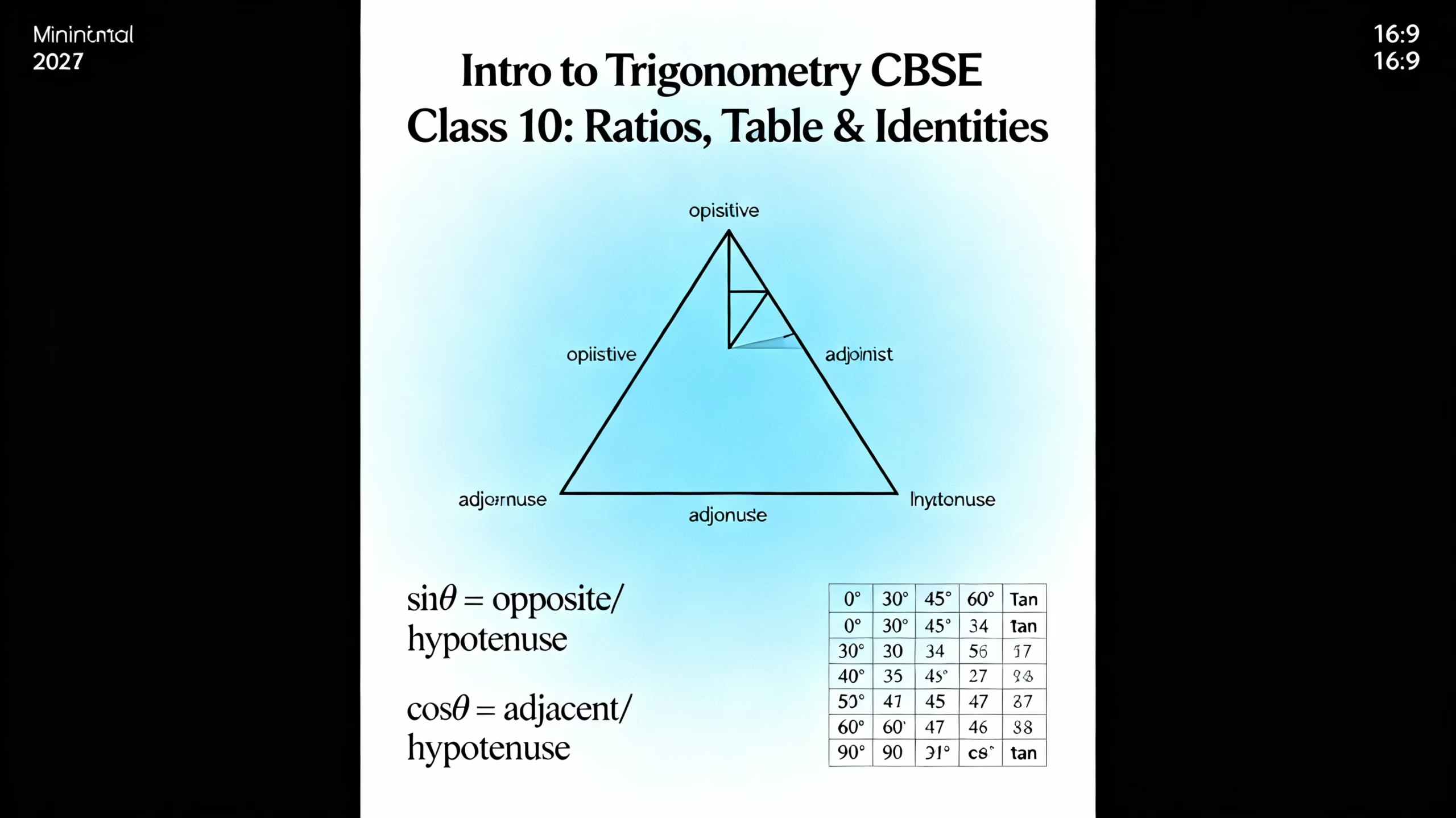
Intro to Trigonometry CBSE Class 10: Ratios, Table & Identities
Welcome to your complete explainer for CBSE Class 10 Maths Chapter 8: Introduction to Trigonometry. This crucial chapter introduces the core concepts of trigonometric ratios (sin, cos, tan), the specific angle value table (0° to 90°), and the fundamental Pythagorean identities. This guide provides clear notes, diagrams, and practice Q&A to help you master every topic for your 2025-26 exams.
Introduction to Trigonometry
Your complete guide to CBSE Class 10, Chapter 8. Understand concepts, ratios, and identities with clear explainers, Q&A, and drawings.
Last Updated: October 2025
Why Study Trigonometry?
Trigonometry is a branch of mathematics that studies relationships between side lengths and angles of triangles. You might wonder, “Why do I need this?”
Imagine you want to find the height of the Qutub Minar without measuring it. If you stand a known distance from its base and measure the angle to its top, you form a “right-angled triangle”. Trigonometry gives you the mathematical tools to calculate the height using just the distance and the angle.
This chapter builds the foundation for these calculations. We will learn the language of trigonometry: the “ratios”.
Visualizing the Problem
The 6 Trigonometric Ratios
All of trigonometry is built on six special ratios. For any acute angle (let’s call it ‘A’) in a right-angled triangle, we define these ratios based on its three sides.
The Primary Ratios
- sine (sin) A = Opposite / Hypotenuse
- cosine (cos) A = Adjacent / Hypotenuse
- tangent (tan) A = Opposite / Adjacent
The Reciprocal Ratios
The other three ratios are simply the reciprocals (1 divided by) of the first three.
| Primary Ratio | Reciprocal Ratio | Definition |
|---|---|---|
| sin A | cosecant (cosec) A = 1 / sin A | Hypotenuse / Opposite |
| cos A | secant (sec) A = 1 / cos A | Hypotenuse / Adjacent |
| tan A | cotangent (cot) A = 1 / tan A | Adjacent / Opposite |
Quotient Relationships
There are two other key relationships that connect the ratios.
Ratios for Specific Angles (0°, 30°, 45°, 60°, 90°)
While trigonometry works for any angle, your exam will focus on five specific angles. Their values come from simple geometry.
Derivation for 45°
We use an isosceles right-angled triangle. Both acute angles are 45°, so the sides opposite them are equal (let’s call them ‘a’).
- By Pythagoras: Hypotenuse = √(a2 + a2) = √(2a2) = a√2
- sin 45° = Opp/Hyp = a / (a√2) = 1 / √2
- cos 45° = Adj/Hyp = a / (a√2) = 1 / √2
- tan 45° = Opp/Adj = a / a = 1
Derivation for 30° & 60°
We use an equilateral triangle (all angles 60°). We drop a perpendicular line (altitude) which splits it into two 30-60-90 triangles.
- Let Hypotenuse = 2a. Base = a.
- By Pythagoras: Height = √((2a)2 – a2) = √(3a2) = a√3
- sin 60° = Opp/Hyp = (a√3) / (2a) = √3 / 2
- cos 60° = Adj/Hyp = a / (2a) = 1 / 2
- sin 30° = Opp/Hyp = a / (2a) = 1 / 2
- cos 30° = Adj/Hyp = (a√3) / (2a) = √3 / 2
Trigonometric Ratios: Value Table
This table summarizes all the values you need to learn. Notice the patterns: the `sin` row is the `cos` row in reverse.
| ∠A | 0° | 30° | 45° | 60° | 90° |
|---|---|---|---|---|---|
| sin A | 0 | 1 / 2 | 1 / √2 | √3 / 2 | 1 |
| cos A | 1 | √3 / 2 | 1 / √2 | 1 / 2 | 0 |
| tan A | 0 | 1 / √3 | 1 | √3 | Not defined |
| cosec A | Not defined | 2 | √2 | 2 / √3 | 1 |
| sec A | 1 | 2 / √3 | √2 | 2 | Not defined |
| cot A | Not defined | √3 | 1 | 1 / √3 | 0 |
Interactive Chart: sin A vs. cos A
This chart shows how `sin A` increases from 0 to 1, while `cos A` decreases from 1 to 0, as the angle `A` goes from 0° to 90°.
The Pythagorean Identities
An “identity” is an equation that is true for *all* values. The three Pythagorean identities are the most important formulas in this chapter. They are all derived from the Pythagorean theorem.
sin2 A + cos2 A = 1
1 + tan2 A = sec2 A
1 + cot2 A = cosec2 A
How They Are Derived (Infographic)
Beyond the 2025-26 Textbook: Complementary Angles
You may see an older topic called “Trigonometric Ratios of Complementary Angles” in some reference books or mind maps. This topic was removed from the NCERT textbook as part of syllabus rationalization.
“Complementary” means two angles add up to 90°. For example, 30° and 60° are complementary. This topic explains *why* the `sin` values match the `cos` values in reverse.
- sin (90° – A) = cos A
- cos (90° – A) = sin A
- tan (90° – A) = cot A
- cot (90° – A) = tan A
- sec (90° – A) = cosec A
- cosec (90° – A) = sec A
Example: sin (90° – 30°) = sin (60°) = √3 / 2. And cos (30°) = √3 / 2. They match. While not required for your exam, knowing this explains the pattern in the value table.
Q&A: Practice Problems
Test your understanding. Try to solve each problem, then click to see the hint or the full answer.
- Let Opposite = 4k, Adjacent = 3k.
- Hypotenuse2 = (4k)2 + (3k)2 = 16k2 + 9k2 = 25k2.
- So, Hypotenuse = 5k.
- sin A = Opp / Hyp = 4k / 5k = 4/5
- cos A = Adj / Hyp = 3k / 5k = 3/5
- cosec A = 1 / sin A = 5/4
- sec A = 1 / cos A = 5/3
- cot A = 1 / tan A = 3/4
- We know: tan 45° = 1, cos 30° = √3 / 2, sin 60° = √3 / 2.
- Substitute these values into the expression:
- = 2 (1)2 + (√3 / 2)2 – (√3 / 2)2
- = 2 (1) + (3 / 4) – (3 / 4)
- = 2 + 0
- = 2
We start with the Left Hand Side (LHS):
LHS = (sec A – cos A)(cot A + tan A)
Step 1: Convert all terms to sin and cos.
LHS = ( (1/cos A) – cos A ) ( (cos A/sin A) + (sin A/cos A) )
Step 2: Find common denominators inside the brackets.
LHS = ( (1 – cos2 A) / cos A ) ( (cos2 A + sin2 A) / (sin A cos A) )
Step 3: Use the Pythagorean identities: (1 – cos2 A) = sin2 A and (cos2 A + sin2 A) = 1.
LHS = ( sin2 A / cos A ) ( 1 / (sin A cos A) )
Step 4: Multiply the fractions.
LHS = sin2 A / (sin A cos2 A)
Step 5: Cancel one `sin A` from the top and bottom.
LHS = sin A / cos2 A
Step 6: Separate the fraction to match the RHS.
LHS = (sin A / cos A) (1 / cos A)
LHS = (tan A) (sec A) = tan A sec A
LHS = RHS. Hence, proved.
Frequently Asked Questions (FAQs)
Why is tan 90° “Not defined”?
`tan A = sin A / cos A`. At 90°, `sin 90° = 1` and `cos 90° = 0`. This means `tan 90° = 1 / 0`. Division by zero is undefined in mathematics.
What is the “k” method used in Problem 1?
When we are given a ratio like `tan A = 4/3`, it means the *ratio* of Opposite to Adjacent is 4:3. The sides are not necessarily 4 and 3. They could be 8 and 6, or 12 and 9. The “k” represents this unknown multiplier. We write Opposite = 4k and Adjacent = 3k. When we form the final ratios (like sin A = 4k / 5k), the ‘k’ cancels out, giving us the correct numerical value (4/5).
What is the best way to remember the identities?
First, memorize `sin2 A + cos2 A = 1`. This one is essential.
For the other two, you can derive them:
1. Take `sin2 A + cos2 A = 1` and divide every term by `cos2 A`. You get `(sin2 A / cos2 A) + (cos2 A / cos2 A) = (1 / cos2 A)`, which simplifies to `tan2 A + 1 = sec2 A`.
2. Take `sin2 A + cos2 A = 1` and divide every term by `sin2 A`. You get `(sin2 A / sin2 A) + (cos2 A / sin2 A) = (1 / sin2 A)`, which simplifies to `1 + cot2 A = cosec2 A`.