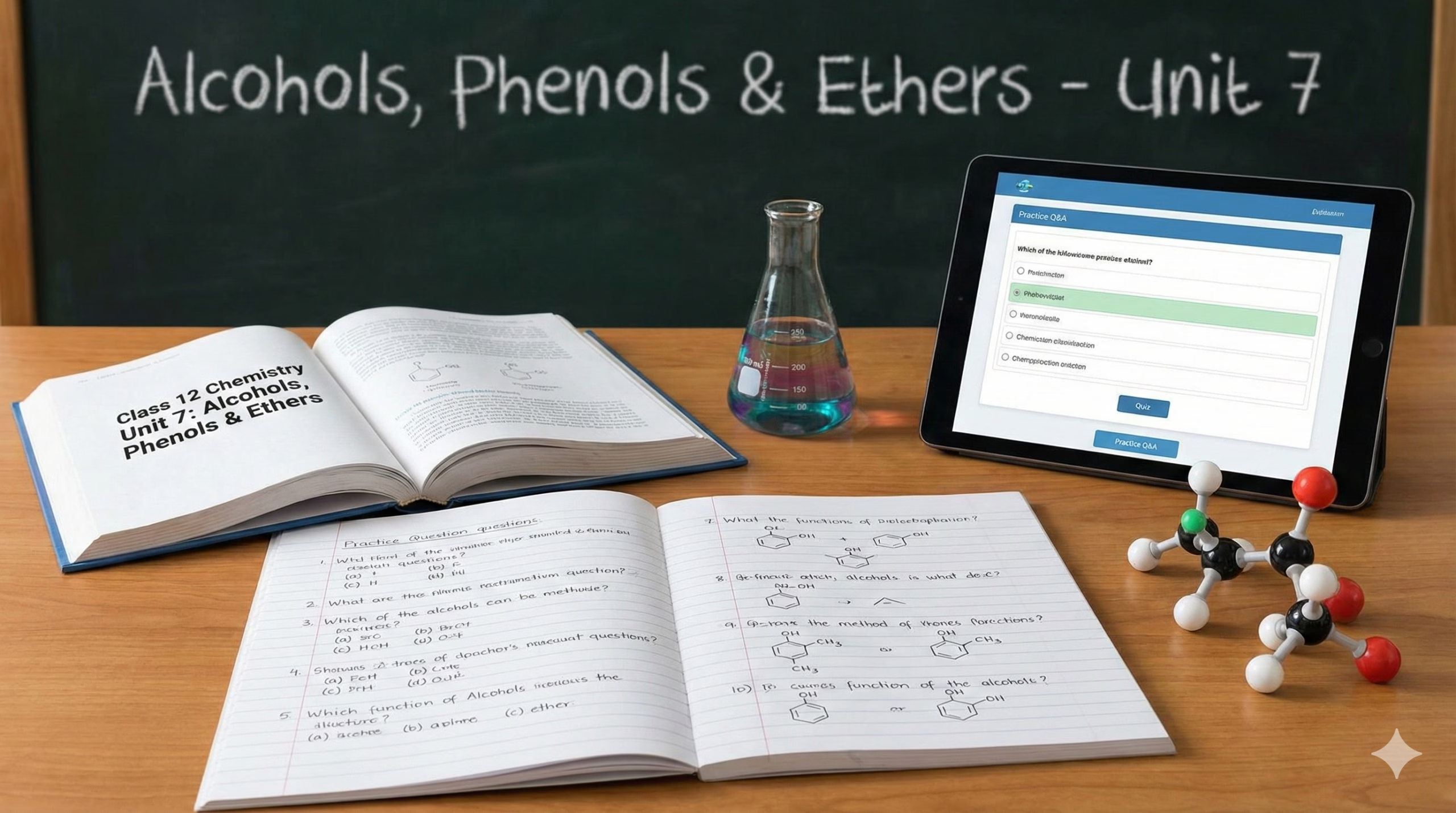
Class 12 Chemistry Unit 7: Alcohols, Phenols & Ethers Practice Q&A
Organic compounds containing Carbon-Oxygen bonds form a substantial part of the Class 12 Chemistry curriculum. This interactive guide focuses on Unit 7, providing a structured approach to understanding Alcohols, Phenols, and Ethers through direct application and problem-solving.
We examine essential preparation methods, such as Hydroboration-Oxidation and the Cumene process, alongside physical properties like boiling point variations caused by hydrogen bonding.
The content also details core reaction mechanisms, including acid-catalyzed dehydration and electrophilic substitution, while offering visual aids for the Lucas Test and acidity comparisons to assist with board and entrance exam preparation.
Rezyo.in
Class XII Chemistry Unit 7 • 2025-26
Reaction Roadmap: Phenol
Other Key Phenol Pathways:
Phenol + CHCl₃ + NaOH → Salicylaldehyde
Phenol + NaOH + CO₂ → Salicylic Acid
Phenol + Na₂Cr₂O₇/H⁺ → Benzoquinone
Commercially Important Alcohols
Methanol (Wood Spirit)
- Formula: CH₃OH
- Production: Catalytic hydrogenation of CO (CO + 2H₂ at high P/T with ZnO-Cr₂O₃).
- Safety: Highly toxic. Ingestion causes blindness/death.
- Uses: Solvent for paints, varnishes; preparation of HCHO.
Ethanol (Grain Alcohol)
- Formula: C₂H₅OH
- Production: Fermentation of sugars (Molasses) by Zymase enzyme.
- Denaturation: Made unfit for drinking by adding CuSO₄ (color) and Pyridine (smell).
- Uses: Solvent, fuel, antiseptic.
Visual Synthesis Logic: Williamson Ether
How to choose reactants for R-O-R’ synthesis?
+
Tertiary Alkoxide
Nucleophile attacks unhindered Primary C.
+
Primary Alkoxide
Base extracts proton due to steric hindrance.
Acidity Trends Analyzer
Effect of Electron Withdrawing Groups (EWG) vs Donating Groups (EDG).
Distinction Tests
Reagent: Conc. HCl + ZnCl₂
- 3°: Immediate Turbidity
- 2°: Turbidity ~5 min
- 1°: No reaction at RT
For Phenols
Produces Violet color complex.
Reagent: NaOH + I₂
Yellow PPT for Ethanol & Sec-Alcohols with CH₃-CH(OH)- group.
Dehydration of Ethanol
Ethanol → Ethene (at 443 K)
1. Protonation
C₂H₅OH + H⁺ ⇌ C₂H₅O⁺H₂
2. Carbocation (Slow)
C₂H₅O⁺H₂ → CH₃C⁺H₂ + H₂O
3. Elimination
CH₃C⁺H₂ → CH₂=CH₂ + H⁺
Hydration of Ethene
Ethene → Ethanol (Prep of Alcohol)
1. Protonation (Markovnikov)
C=C + H₃O⁺ ⇌ C-C⁺ + H₂O
2. Nucleophilic Attack
C-C⁺ + H₂O ⇌ C-C-O⁺H₂
3. Deprotonation
C-C-O⁺H₂ + H₂O ⇌ C-C-OH + H₃O⁺