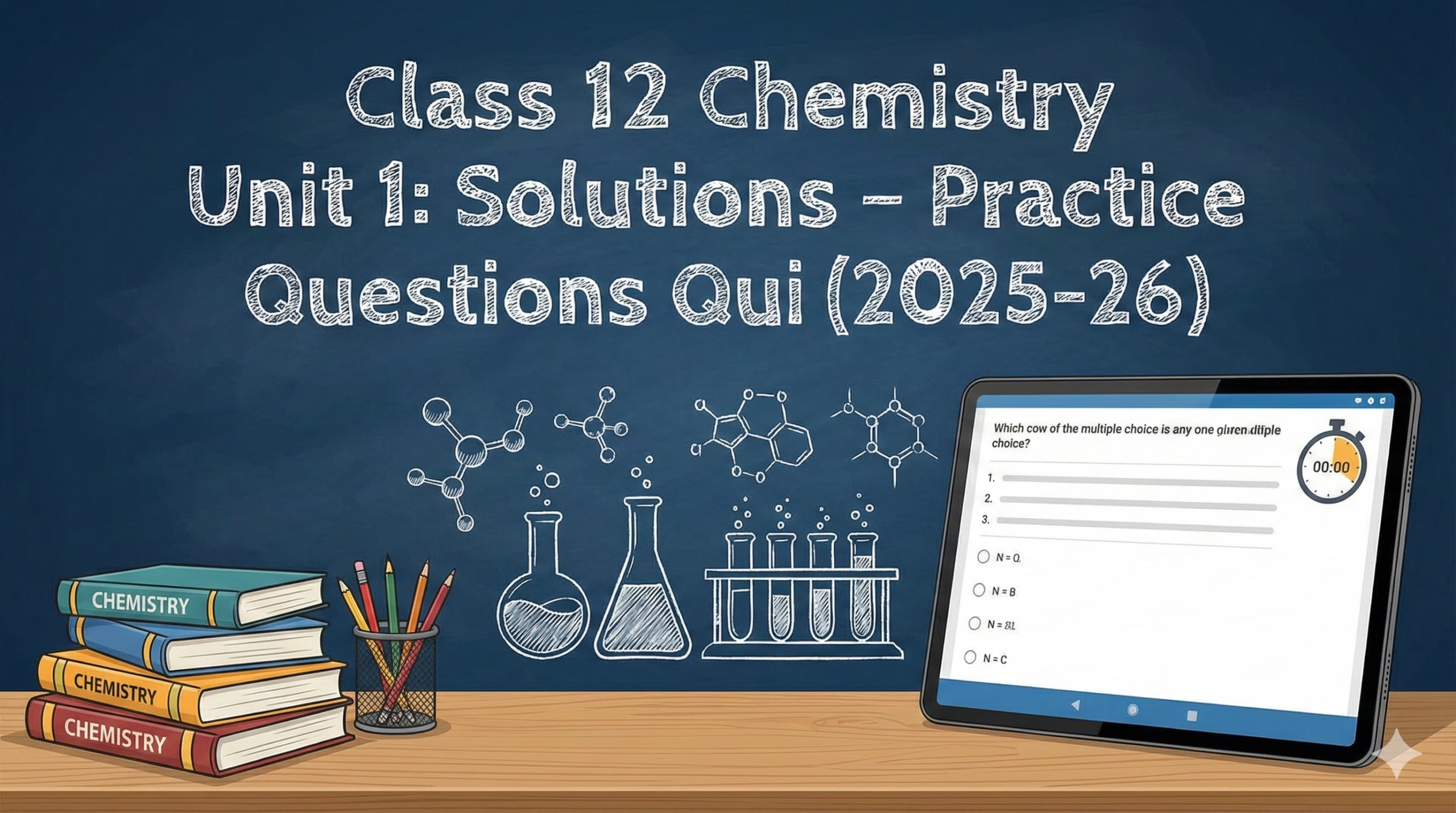
Class 12 Chemistry Unit 1: Solutions – Practice Questions Quiz (2025-26)
Physical Chemistry often feels abstract until you see how the variables interact. Unit 1: Solutions establishes the mathematical framework for the Class 12 syllabus, linking concentration terms to observable changes in vapor pressure and boiling points. This page moves beyond static textbook definitions to offer a hands-on learning experience.
Here, you will find a dynamic dashboard to test your grasp of Molarity, Molality, and Henry’s Law in real-time. We break down the thermodynamics behind Ideal and Non-Ideal solutions using comparison matrices and deviation logic trees, allowing you to predict positive or negative deviations without rote memorization. From visualizing surface barriers in vapor pressure to calculating the Van’t Hoff factor for complex ions, this resource aligns strictly with the 2025-26 academic standards to prepare you for board exams and competitive tests.
Rezyo.in
Class XII Chemistry Unit 1 • 2025-26
Thermodynamics of Solution Mixing
Solubility Dynamics
Solid in Liquid
- Effect of Pressure Negligible
- Temp (Endothermic $\Delta H > 0$) Increases
- Temp (Exothermic $\Delta H < 0$) Decreases
Gas in Liquid
- Effect of Pressure Increases (Henry’s Law)
- Effect of Temp Decreases
- Henry’s Constant ($K_H$) Higher $K_H$ = Lower Solubility
Azeotrope Classification Hub
Minimum Boiling Azeotrope
Deviation: Large Positive
Example: Ethanol (95.5%) + Water (4.5%)
BP: 351.15 K (Lower than water 373K)
Maximum Boiling Azeotrope
Deviation: Large Negative
Example: Nitric Acid (68%) + Water (32%)
BP: 393.5 K (Higher than water 373K)
Visual Concept: Surface Barrier Effect
Why does adding a non-volatile solute lower vapour pressure?
Raoult’s Law Deviations
Deviation Logic Tree
Solute (A) & Solvent (B)
Conceptual Doubts (FAQ)
Q: Why does adding salt to ice melt it (Depression in Freezing Point)?
Adding a non-volatile solute (salt) lowers the freezing point of the solvent (water). If the ambient temperature is higher than this new, lowered freezing point (e.g., -5°C), the ice cannot exist as a solid and melts into liquid water.
Q: Why are aquatic species more comfortable in cold water?
This relates to Henry’s Law. The value of Henry’s constant ($K_H$) increases with temperature. Since solubility is inversely proportional to $K_H$, the solubility of oxygen decreases as water gets warmer.
Q: What is the medical condition “Edema”?
Excess salt intake increases ion concentration in tissue fluids. Water moves out of cells via osmosis to balance this, causing water retention and puffiness known as Edema.
Chapter Summary & Outcomes
You have navigated the complexities of Solution Chemistry. From mastering concentration units to applying the Van’t Hoff factor for ionic compounds, these concepts form the bedrock of Physical Chemistry.