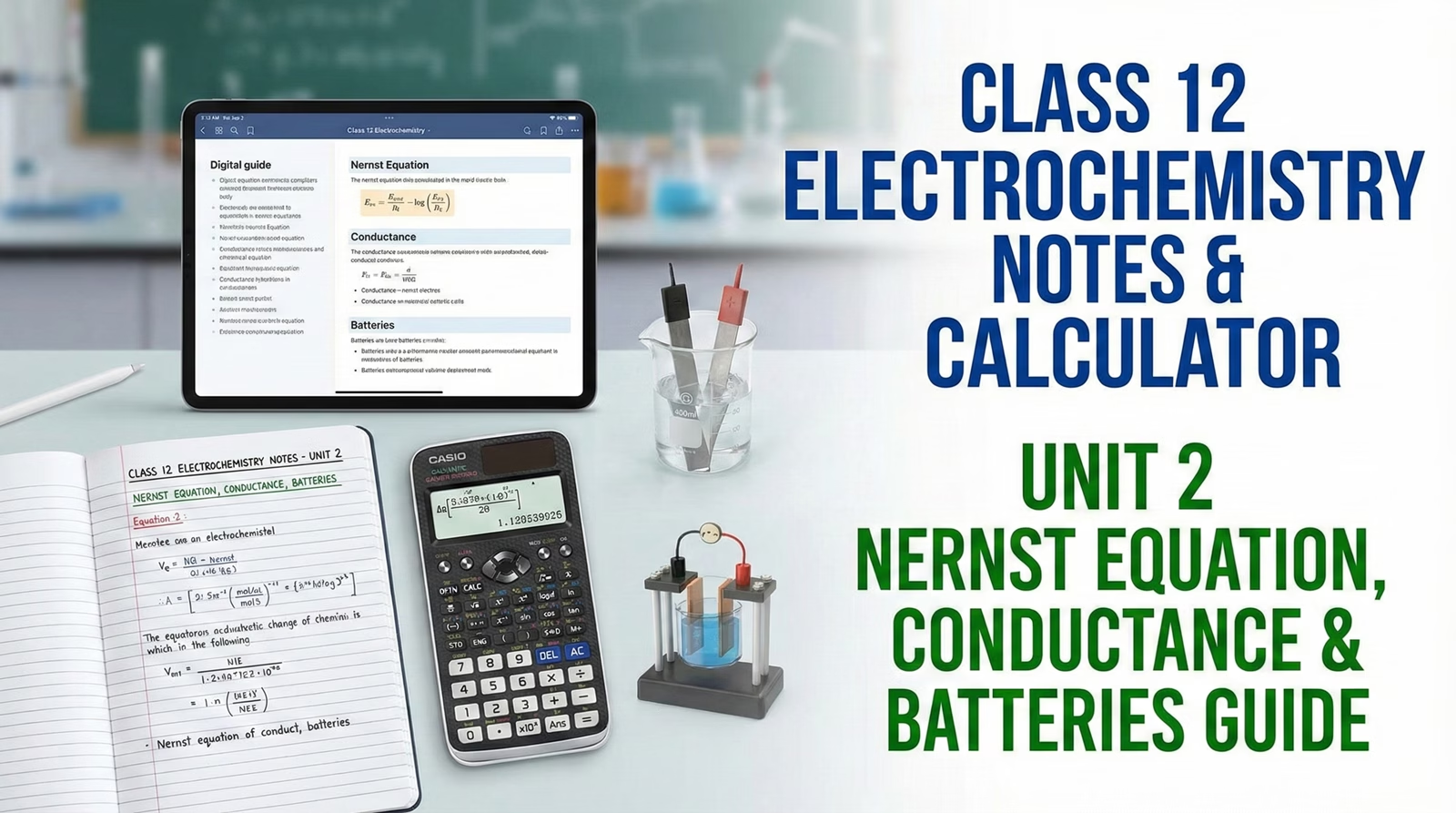
Class 12 Electrochemistry Notes & Calculator | Unit 2 Nernst Equation, Conductance & Batteries Guide
Electrochemistry connects spontaneous chemical reactions to electrical energy production. This Unit 2 syllabus guide simplifies electrolytic conductance, the Nernst equation, and the working principles of commercial batteries.
Students can compute cell potentials directly with the built-in calculator, track ion migration through visual animations, and test their grasp of Faraday’s Laws with the integrated quiz. From the standard hydrogen electrode to the chemistry of rusting, these notes prioritize exam-focused concepts and numerical problem-solving.
Electrochemistry:
From Ions to Energy
A comprehensive guide to understanding how chemical energy powers our world. Covers conduction, Nernst equation, commercial batteries, and corrosion.
01 Electrolytic Conductance
Unlike metallic wires where electrons flow through a lattice, electrolytic conduction relies on the physical movement of ions. This creates a unique relationship between concentration and resistance.
κ = G × G*
Where G is Conductance and G* is the Cell Constant (l/A)
Λm = (κ × 1000) / C
Units: S cm2 mol-1
Visualizing Dilution Effect
Animation: As water is added (Dilution), ions move apart.
κ decreases (fewer ions/vol), but Λm increases (higher mobility).
Factors Affecting Electrolytic Conductance
1. Nature of Electrolyte
Strong electrolytes dissociate completely (high conductance). Weak electrolytes dissociate partially (low conductance).
2. Size of Ions & Solvation
Larger ions (due to hydration) move slower. Example: Li+ is heavily hydrated and moves slower than Cs+.
3. Nature of Solvent & Viscosity
Polar solvents favor ionization. Higher viscosity resists ion flow, lowering conductance.
4. Temperature
Unlike metals, electrolytic conductance increases with temperature as kinetic energy increases and interionic attractions weaken.
Strong vs. Weak Electrolytes
| Feature | Strong Electrolyte (e.g., KCl) | Weak Electrolyte (e.g., CH3COOH) |
|---|---|---|
| Dissociation | Complete at all concentrations. | Partial. Increases with dilution. |
| Conductivity Rise | Gradual linear increase. | Steep, exponential increase near zero conc. |
| Reason | Reduced interionic drag. | Increase in number of ions (Ostwald Law). |
| Limiting Value | Found by extrapolation of graph. | Found using Kohlrausch Law. |
02 Conductivity Trends
03 Kohlrausch’s Law of Independent Migration
At infinite dilution, every ion makes a definite contribution towards the molar conductivity of the electrolyte, regardless of the nature of the other ion it is associated with.
Application: This law is critical for calculating the limiting molar conductivity (Λ°m) for weak electrolytes, which cannot be determined graphically.
04 Nernst Equation & Gibbs Energy
The Nernst equation links the potential of a cell to the concentration of species involved. It bridges thermodynamics and electrochemistry.
Ecell = E°cell – (0.0591 / n) log Q
ΔG° = -nFE°cell
n = moles of electrons, F = 96500 C
Equilibrium Constant & Cell Potential
When an electrochemical cell reaches equilibrium, the reaction stops flowing. At this stage, Ecell = 0 and the reaction quotient Q becomes Kc (Equilibrium Constant).
05 Nernst Equation Calculator
Calculate the cell potential ($E_{cell}$) for a reaction at 298K.
Cell Potential ($E_{cell}$)
06 Electrochemical Series Explorer
The Reference: Standard Hydrogen Electrode (SHE)
Since individual half-cell potentials cannot be measured, the SHE is the universal reference.
- Setup: Platinum foil coated with platinum black dipped in 1M H⁺ solution.
- Convention: Its potential is arbitrarily fixed at 0.00 V at all temperatures.
- Role: Acts as Anode or Cathode depending on the other half-cell.
07 Faraday’s Laws Calculator
First Law: The mass of substance deposited is directly proportional to the charge passed. (m = ZIt).
Mass Deposited
Formula Used: m = (M × I × t) / (n × 96500)
08 Deep Dive: Electrolysis Products
Predicting products of electrolysis requires analyzing Standard Potentials and considering Overpotential.
Case A: Molten NaCl
Only two ions exist: Na+ and Cl–.
- Cathode: Na+ + e– → Na(s)
- Anode: Cl– → ½Cl2 + e–
Case B: Aqueous NaCl (Brine)
Competition with Water molecules.
-
At Cathode:
H+ discharges (E°=0.0V) instead of Na+ (E°=-2.71V).
Product: H2 gas. -
At Anode:
Cl– oxidizes to Cl2. Oxygen is expected (lower E°), but Overpotential makes Cl2 easier to form.
Product: Cl2 gas.
Comparison: The Two Cell Types
| Parameter | Electrochemical (Galvanic) Cell | Electrolytic Cell |
|---|---|---|
| Energy Conversion | Chemical Energy → Electrical Energy | Electrical Energy → Chemical Energy |
| Spontaneity | Spontaneous (ΔG < 0) | Non-Spontaneous (ΔG > 0) |
| Anode Charge | Negative (-) | Positive (+) |
| Cathode Charge | Positive (+) | Negative (-) |
09 Commercial Batteries
Dry Cell (Leclanché)
Primary- • Anode: Zinc Container
- • Cathode: Carbon (Graphite) rod
- • Voltage: ~1.5 V (Non-constant)
Mercury Cell
Primary- • Anode: Zn-Hg Amalgam
- • Cathode: Paste of HgO + C
- • Voltage: 1.35 V (Constant)
- • Key Fact: No ions in overall reaction.
Lead Storage Battery
Secondary- • Anode: Pb (Lead)
- • Cathode: PbO2
- • Electrolyte: 38% H2SO4
Nickel-Cadmium (NiCd)
Secondary- • Anode: Cadmium (Cd)
- • Cathode: Ni(OH)3
- • Voltage: ~1.4 V
- • Life: Longer life than Lead storage.
Fuel Cell Efficiency Focus
Fuel cells, like the H2-O2 cell used in the Apollo space program, convert energy of combustion directly into electricity.
10 Corrosion: Electrochemical Theory
Rusting of iron is essentially setting up of a tiny electrochemical cell on the surface of the metal.
Prevention: Barrier protection (painting), Galvanization (coating with Zinc), or Cathodic Protection (connecting to Mg or Zn).
11 Quick Check Quiz
1. For a spontaneous reaction, ΔG must be:
2. In an Electrolytic cell, the Anode is:
3. The unit of Molar Conductivity is:
12 Exam Focus Q&A & Doubts
Q1: Why does conductivity decrease but molar conductivity increase with dilution?
+Think about ions per unit volume vs total volume.
Conductivity (κ) decreases because the number of ions per unit volume decreases on dilution.
Molar Conductivity (Λm) increases because the volume containing one mole of electrolyte increases significantly, outweighing the decrease in κ.
What is the exact function of a Salt Bridge?
1. Completes the electrical circuit.
2. Maintains electrical neutrality by allowing flow of ions.
Difference between EMF and Potential Difference?
- EMF: Potential diff when no current flows (Max voltage).
- Potential Diff: Potential diff when current is flowing (Less than EMF).
⚡ Key Formula Cheat Sheet
G = 1/R = κ (A/l)
Cell Constant (G*) = l/A
α = Λm / Λ°m
ΔG° = -nFE°cell
Glossary of Terms
Conclusion
Electrochemistry connects chemical reactions with electricity. This master guide has covered everything from fundamental conductance to complex commercial batteries. Remember to practice the numericals using the provided calculators and review the cheat sheet before exams.
© 2026 Rezyo.in. All rights reserved.