Unit 13 CBSE Chemistry Amines Class 12 Practice Exam with Q&A
Nitrogen-containing organic compounds serve as fundamental building blocks in pharmaceuticals, polymers, and biological systems. This study resource for Class 12 Chemistry Unit 13 examines Amines, categorizing them as alkyl or aryl derivatives of ammonia. The content maps out their pyramidal structure, classification, and physical properties, such as solubility and boiling point variations.
Students will find specific breakdowns of chemical behaviors, including the Carbylamine reaction and Hinsberg’s test, alongside mechanism explanations for Hoffmann Bromamide degradation. We also address the factors influencing basicity in gaseous versus aqueous phases and use interactive visualizers to demonstrate stereochemical concepts like nitrogen inversion.
Rezyo.in
Class XII Unit 13: Amines
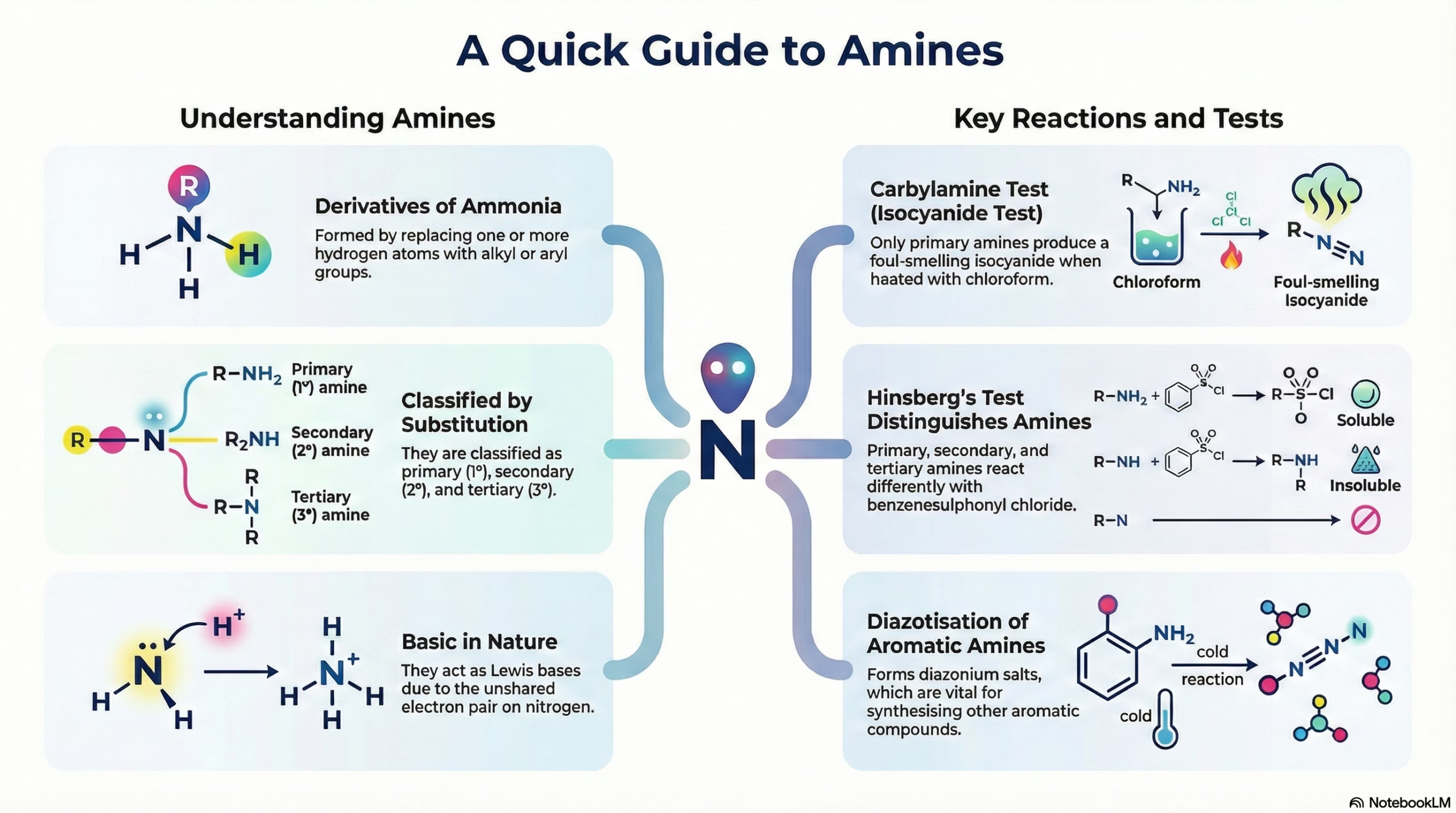
Amines: Organic Derivatives of Ammonia
Amines are versatile organic compounds derived by replacing hydrogen atoms of ammonia with alkyl or aryl groups. This guide covers the complete 2025-26 syllabus for Unit 13, including structure, basicity trends, key preparation methods like Gabriel Phthalimide synthesis, and distinguishing tests like Hinsberg’s reagent.
Knowledge Check
Pop-out quiz with timer to test your speed.
Unit 13 Challenge
Test your understanding of basicity orders, name reactions, and chemical tests. You have 25 questions. The clock starts when you click below.
Classification & Structure
Primary
\( R-NH_2 \)
One alkyl/aryl group
Secondary
\( R-NH-R’ \)
Two alkyl/aryl groups
Tertiary
\( R_3N \)
Three alkyl/aryl groups
Key Preparation Methods
Nitrogen Inversion (Umbrella Flip)
Rapid oscillation of the nitrogen atom through the plane of substituents makes isolation of enantiomers impossible at room temperature.
Important Chemical Reactions
Carbylamine Reaction (Isocyanide Test)
Test for 1° AminesHinsberg’s Test (Distinction)
Forms sulphonamide soluble in alkali.
Forms sulphonamide insoluble in alkali.
Does not react with Hinsberg’s reagent.
Frequently Asked Questions
Why are aliphatic amines stronger bases than aromatic amines?
In aromatic amines (e.g., aniline), the lone pair on Nitrogen is involved in resonance with the benzene ring, making it less available for protonation. In aliphatic amines, alkyl groups show +I effect, increasing electron density on N.
Why does aniline not undergo Friedel-Crafts reaction?
Aniline is a Lewis base and reacts with the Lewis acid catalyst (\( AlCl_3 \)) to form a salt. This places a positive charge on N, making it a strong deactivating group.
Why are amines soluble in water?
Lower aliphatic amines can form hydrogen bonds with water molecules. Solubility decreases with increasing molar mass due to the larger hydrophobic alkyl part.
What is the basicity order of amines in aqueous solution?
For ethyl groups: \( 2^\circ > 3^\circ > 1^\circ > NH_3 \).
For methyl groups: \( 2^\circ > 1^\circ > 3^\circ > NH_3 \).
This order depends on inductive effect, solvation effect, and steric hindrance.
Why is aniline acetylated before nitration?
Direct nitration causes oxidation of aniline to tarry products. Acetylation protects the amino group and decreases its activating effect (due to resonance of lone pair with carbonyl), preventing polysubstitution and oxidation.
Why are aromatic diazonium salts more stable than aliphatic ones?
Aromatic diazonium salts are stabilized by resonance dispersal of the positive charge into the benzene ring. Aliphatic diazonium salts lack this stabilization and decompose immediately to liberate nitrogen gas and form alcohols.