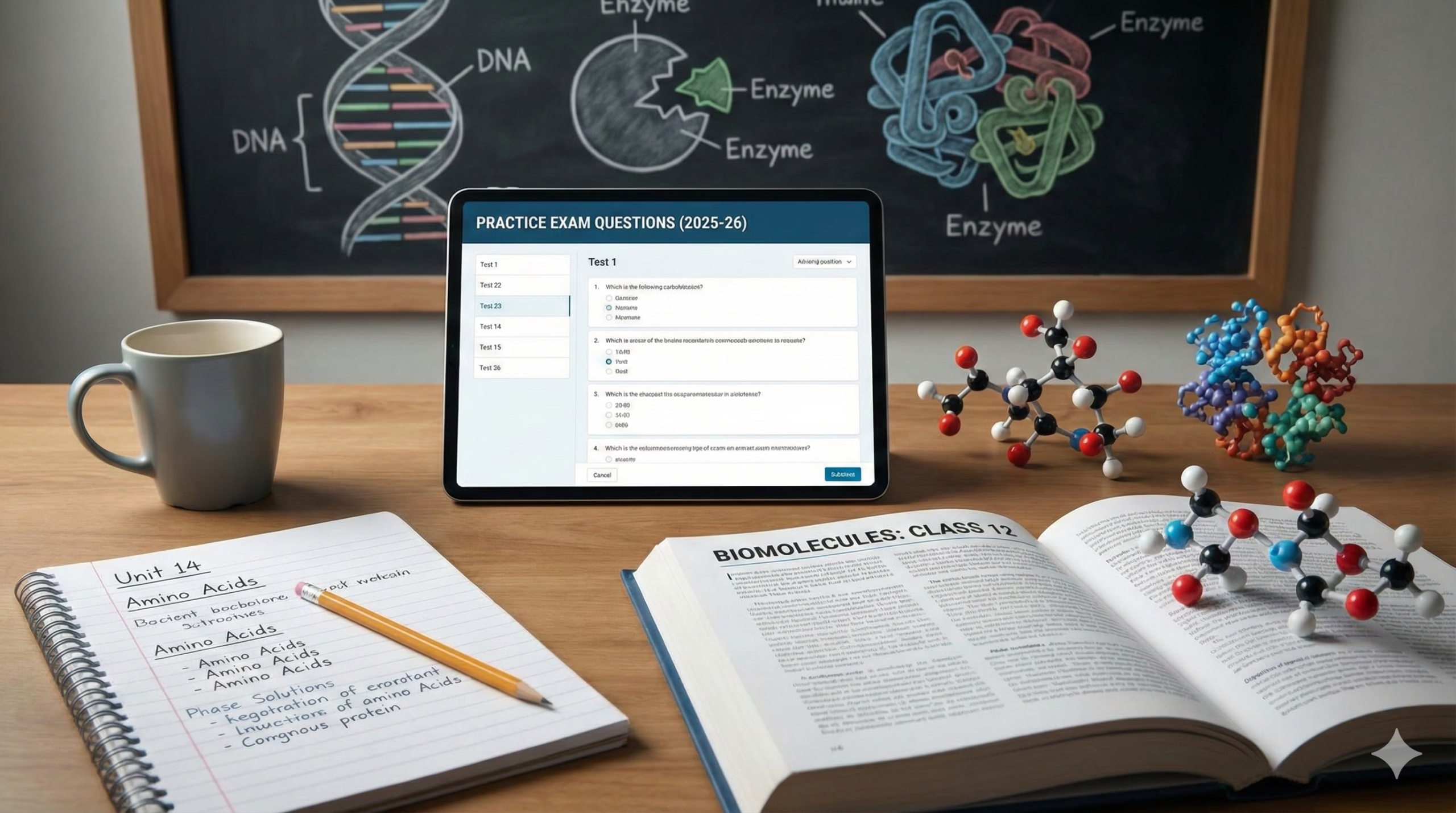
Unit 14 Biomolecules Class 12 (2025-26): Practice Exam Questions
Living organisms operate through the interaction of complex organic compounds. This guide for Unit 14 covers the essential chemistry of Carbohydrates, Proteins, Nucleic Acids, and Vitamins as per the Class XII 2025-26 syllabus.
We examine how Monosaccharides link to form Polysaccharides, the specific folding patterns of Proteins, and the storage of genetic information in DNA and RNA. Use the interactive tools and practice quiz below to verify your grasp of concepts like Glucose oxidation, Peptide bond formation, and Zwitter ion characteristics.
Rezyo.in
Class XII Unit 14: Biomolecules
The Chemistry of Life
Living systems grow, sustain, and reproduce using complex organic molecules. This unit explores the structure and function of carbohydrates (energy sources), proteins (structural building blocks), nucleic acids (genetic information), and vitamins. We examine the chemical logic behind life processes, from the glycosidic linkages in sugars to the peptide bonds in proteins.
Assessment: Biomolecules
Timed challenge on Glucose reactions, DNA bases, and Protein structure.
Test Your Knowledge
Do you know the product of glucose with HI? Can you identify the non-reducing sugar? Start the quiz to verify your preparation.
Glucose Reactions
Evidence for the open-chain structure of Glucose (\(C_6H_{12}O_6\)):
- HI Heating with HI yields n-Hexane. Proves all 6 carbons are in a straight chain.
- \(Br_2\) Water Mild oxidation yields Gluconic Acid. Indicates aldehyde group.
- \(HNO_3\) Strong oxidation yields Saccharic Acid (dicarboxylic). Indicates primary alcohol.
- Acetylation Forms Glucose Pentaacetate. Confirms presence of 5 -OH groups.
Cyclic Structure
Glucose forms a six-membered ring (Pyranose). The -OH at C-5 reacts with the aldehyde group to form a hemiacetal.
Proteins & Structure
Amino Acids & Peptides
Proteins are polymers of \(\alpha\)-amino acids linked by peptide bonds (-CO-NH-).
In aqueous solution, the carboxyl group loses a proton (\(COO^-\)) and the amino group accepts a proton (\(NH_3^+\)). The molecule is electrically neutral but carries charges.
Amino acids that the body cannot synthesize (e.g., Valine, Leucine). Non-essential ones (e.g., Glycine) are synthesized by the body.
Levels of Structure
-
1
Primary
Specific sequence of amino acids. Determined by genetic information.
-
2
Secondary
Regular folding (H-bonds). \(\alpha\)-helix (right-handed screw) and \(\beta\)-pleated sheet.
-
3
Tertiary & Quaternary
Overall 3D folding (Disulphide links, van der Waals). Quaternary is the arrangement of multiple subunits.
Nucleic Acids (DNA & RNA)
DNA (Deoxyribonucleic Acid)
- Sugar: \(\beta\)-D-2-deoxyribose.
- Bases: Adenine (A), Guanine (G), Cytosine (C), Thymine (T).
- Structure: Double helix held by H-bonds (A=T, C≡G).
- Function: Genetic reserve, heredity, self-replication.
RNA (Ribonucleic Acid)
- Sugar: \(\beta\)-D-ribose.
- Bases: Adenine (A), Guanine (G), Cytosine (C), Uracil (U).
- Structure: Single strand (sometimes folds back).
- Function: Protein synthesis (mRNA, tRNA, rRNA).
Frequently Asked Questions
Why is Sucrose a non-reducing sugar?
In sucrose, the reducing groups (aldehyde of glucose and ketone of fructose) are involved in the glycosidic bond formation (C1 of Glucose and C2 of Fructose). Since there is no free reducing group, it does not reduce Tollens’ reagent or Fehling’s solution.
What happens during the denaturation of proteins?
When subjected to heat or pH change, the hydrogen bonds are disturbed. Globules unfold and helices uncoil. The protein loses its biological activity. Note: Secondary and tertiary structures are destroyed, but the primary structure (sequence of amino acids) remains intact.
What are reducing sugars?
All carbohydrates containing a free aldehyde or ketone group that can reduce Fehling’s solution and Tollens’ reagent are reducing sugars. Examples include Glucose, Fructose, Maltose, and Lactose.