Class 12 Chemistry: Aldehydes, Ketones & Carboxylic Acids – Reactions, Mechanisms & Q&A
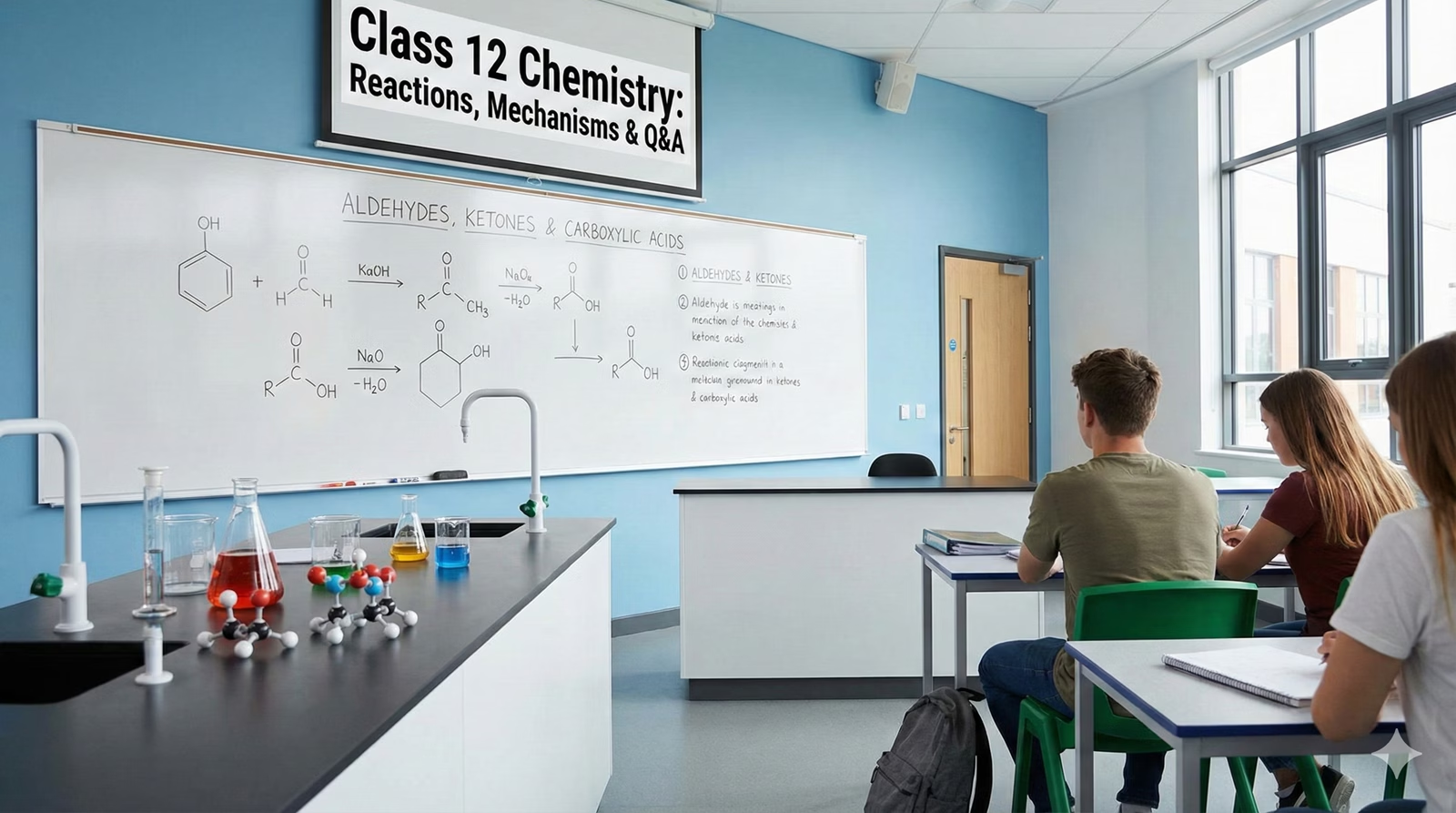
The chemistry of Aldehydes, Ketones, and Carboxylic Acids focuses on the carbonyl group (>C=O), the structural feature that dictates reactivity in this class of organic compounds. This guide outlines specific preparation methods, such as the Etard reaction and Grignard synthesis, while explaining the electron shifts behind nucleophilic attacks and acidity trends.
You will find detailed breakdowns of mechanism-driven processes like Esterification and Clemmensen reduction, alongside practical lab tests used to distinguish between functional groups. Use these notes to solve conversion problems and answer reasoning-based questions found in standard board examinations.
Aldehydes, Ketones, and Carboxylic Acids
This unit bridges hydrocarbon chemistry and biochemistry. The carbonyl group (>C=O) dictates the properties and reactivity. Mastery here involves understanding electron density shifts, nucleophilic attacks, and acidity trends.
The Carbonyl Center
Nomenclature & Structure
| Group | Suffix | Example |
|---|---|---|
| Aldehyde | -al | Ethanal (CH3CHO) |
| Ketone | -one | Propanone (CH3COCH3) |
| Carboxylic Acid | -oic acid | Ethanoic acid (CH3COOH) |
Visual Mechanisms & Tests
Distinguishing Tests
(Silver Mirror)
(Red Ppt)
(Yellow Ppt)
Carboxylate Resonance
Key Preparation Reactions
Rosenmund Reduction
Aldehydes OnlyConverts Acid Chlorides to Aldehydes using poisoned catalyst to prevent over-reduction.
Stephen Reduction
From NitrilesNitriles reduced to imines with SnCl2/HCl, then hydrolyzed.
Etard Reaction
Toluene → BenzaldehydeChromyl chloride oxidizes methyl group to a chromium complex, hydrolyzed to aldehyde.
Friedel-Crafts Acylation
Aromatic KetonesElectrophilic substitution on benzene ring using acyl halide.
Preparation of Carboxylic Acids
From Alkylbenzenes
Vigorous oxidation of alkylbenzenes with chromic acid or alkaline KMnO4 gives benzoic acid. The entire alkyl chain is oxidized to -COOH group regardless of length.
From Grignard Reagents
Grignard reagents react with solid Carbon Dioxide (Dry Ice) to form salts of carboxylic acids, which give corresponding acids on acidification.
From Nitriles & Amides
Nitriles are hydrolysed to amides and then to acids in the presence of H+ or OH– as catalyst.
From Esters
Acidic hydrolysis of esters gives directly carboxylic acids while basic hydrolysis gives carboxylates, which on acidification give corresponding acids.
High-Yield Study Notes
Aldol vs. Cannizzaro
The deciding factor is the α-hydrogen.
• With α-H → Aldol Condensation.
• Without α-H → Cannizzaro Reaction.
Example: Acetaldehyde (Aldol), Formaldehyde (Cannizzaro).
Acidity Trend
Electron Withdrawing Groups (EWG) increase acidity by stabilizing the carboxylate ion.
Order: CF3COOH > CCl3COOH > CH3COOH
Grignard Reagent
Always use dry ether. Any moisture will protonate the Grignard reagent (RMgX), destroying it to form a hydrocarbon (R-H).
The Ortho Effect
Ortho-substituted benzoic acids are stronger than their meta and para isomers, regardless of whether the substituent is electron-donating or withdrawing.
Properties & Solubility
Boiling Point Comparison
Compounds with similar molecular mass.
Solubility Trends
- Lower Members: Miscible in water due to Hydrogen bonding with water molecules.
- Higher Members: Solubility decreases rapidly as the hydrophobic alkyl chain length increases.
- Organic Solvents: All aldehydes and ketones are fairly soluble in organic solvents like benzene and ether.
Nucleophilic Addition Reactions
Reactivity Order: Aldehydes > Ketones
- Steric Hindrance: Ketones have two bulky alkyl groups blocking the attack.
- Electronic Effect: Alkyl groups (+I effect) reduce positive charge on Carbon.
Addition of Ammonia Derivatives
General Reaction: >C=O + H2N-Z → >C=N-Z + H2O
| Reagent (H2N-Z) | Z-Group | Product Name |
|---|---|---|
| Hydroxylamine | -OH | Oxime |
| Hydrazine | -NH2 | Hydrazone |
| Phenylhydrazine | -NHC6H5 | Phenylhydrazone |
| 2,4-DNP | -NHC6H3(NO2)2 | 2,4-DNP Derivative |
| Semicarbazide | -NHCONH2 | Semicarbazone |
Reduction & Oxidation
Clemmensen Reduction
Uses Zinc Amalgam and conc. HCl to reduce carbonyl group to -CH2-.
Wolff-Kishner Reduction
Uses Hydrazine followed by KOH/glycol heating.
Oxidation of Methyl Ketones (Haloform Reaction)
Methyl ketones react with Sodium Hypohalite (NaOX) to form a haloform (CHX3) and sodium salt of carboxylic acid. This is the basis of the Iodoform Test.
R-CO-CH3 + 3NaOX → R-COONa + CHX3 + 2NaOH
Name Reactions: α-Hydrogen
Aldol Condensation
Needs α-HTwo molecules of aldehyde/ketone condense in the presence of dilute alkali (NaOH) to form β-hydroxy aldehyde (Aldol), which dehydrates on heating to give α,β-unsaturated aldehyde.
(3-Hydroxybutanal / Aldol)
→(Heat, -H2O)→ CH3-CH=CH-CHO (But-2-enal)
Cross Aldol Condensation
Between two different aldehydes/ketones. If both have α-hydrogens, a mixture of 4 products is obtained. If only one has α-hydrogen, cross product is major.
Cannizzaro Reaction
No α-HDisproportionation reaction where one molecule is oxidized to acid salt and another reduced to alcohol. Requires concentrated alkali (50% NaOH/KOH).
(Methanol + Pot. Formate)
Carboxylic Acid Reactions
Hell-Volhard-Zelinsky (HVZ) Reaction
Specific for substituting α-hydrogen of carboxylic acids with Halogen (Cl, Br).
Used to synthesize α-amino acids.
Esterification
Reaction with alcohol in presence of conc. H2SO4.
Anhydride Formation
Dehydration using P2O5 or conc. H2SO4.
Reaction with PCl5 / SOCl2
Hydroxyl group replacement. SOCl2 is preferred as by-products are gases.
Reaction with Ammonia
Forms ammonium salt, which on heating gives amide.
Decarboxylation
Heating sodium salt with Soda Lime (NaOH + CaO).
Ring Substitution
-COOH is meta-directing and deactivating.
Uses of Common Compounds
- Methanal: Manufacture of Bakelite, urea-formaldehyde glues; 40% solution (Formalin) preserves biological specimens.
- Ethanal: Starting material for acetic acid, ethyl acetate, vinyl acetate, and drugs.
- Acetone: Common solvent for paints, nail polish remover; manufacture of polymers.
- Benzoic Acid: Food preservative (Sodium Benzoate), manufacture of dyes and perfumes.
Lab Tests & Distinctions
| Test | Reagent | Positive Result | Identifies |
|---|---|---|---|
| Tollens’ | Ammoniacal AgNO3 | Silver Mirror | All Aldehydes |
| Fehling’s | CuSO4 + Tartrate | Red Ppt | Aliphatic Aldehydes Only |
| Iodoform | I2 + NaOH | Yellow Ppt | Methyl Ketones (CH3-C=O) |
| Bicarbonate | NaHCO3 | Effervescence | Carboxylic Acids |
Exam Q&A
Q1: Why are carboxylic acids higher boiling than alcohols of comparable mass?
Q2: Distinguish chemically between Pentan-2-one and Pentan-3-one.
Pentan-2-one contains a methyl ketone group (CH3-CO-) and gives a yellow precipitate of Iodoform (CHI3) when treated with I2/NaOH.
Pentan-3-one lacks this group and gives no precipitate.
Q3: Why does benzaldehyde not undergo Aldol Condensation?
Q4: Arrange the following in increasing order of reactivity towards HCN: Acetaldehyde, Acetone, Di-tert-butyl ketone.
Reason: Steric hindrance increases from acetaldehyde (one alkyl) to acetone (two small alkyls) to di-tert-butyl ketone (two very bulky groups). Greater steric hindrance makes nucleophilic attack by CN– harder.
Q5: Explain why Chloroacetic acid is stronger than Acetic acid.
Frequently Asked Questions
Can methanal be prepared by Rosenmund reduction?
No. Formyl chloride (HCOCl), the required starting material, is unstable at room temperature.
Why are carboxylic acids stronger than phenols?
The carboxylate ion is stabilized by resonance between two equivalent electronegative oxygen atoms. The phenoxide ion disperses charge onto carbon atoms of the ring, which is less effective.
What happens when Acetone reacts with Grignard Reagent?
It yields a tertiary alcohol. The alkyl group from RMgX attacks the ketone carbon.
Is 2,4-DNP test specific for aldehydes?
No, it is a general test for the Carbonyl group. Both aldehydes and ketones give an orange/red precipitate.
What is the role of glycol in Wolff-Kishner reduction?
Glycol (Ethylene glycol) acts as a high-boiling solvent, allowing the reaction mixture to reach the temperatures required for the decomposition of the hydrazone intermediate.