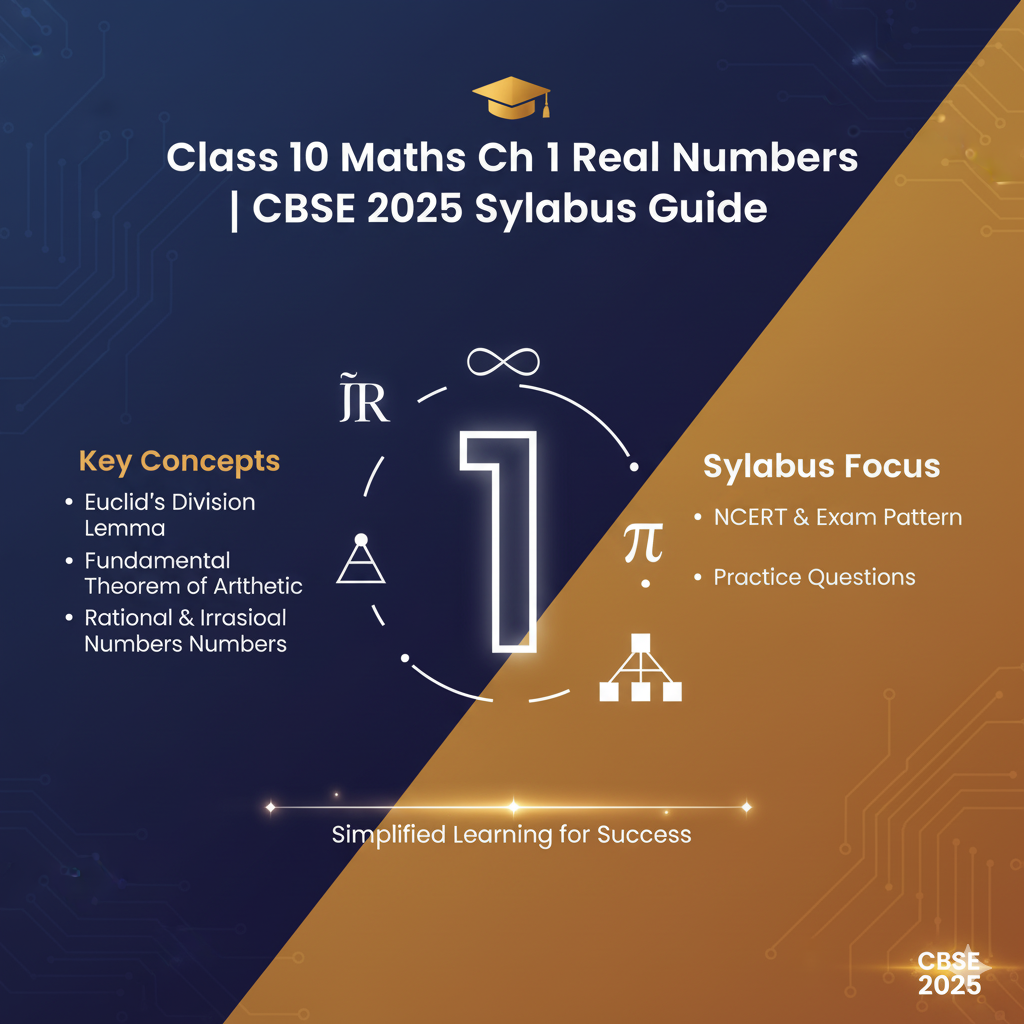
Class 10 Maths Ch 1 Real Numbers | CBSE 2025 Syllabus Guide
Welcome to the complete guide for Class 10 Maths Chapter 1: Real Numbers, fully updated for the 2025 CBSE syllabus. This page focuses on the two core topics: the Fundamental Theorem of Arithmetic (HCF/LCM) and Proofs of Irrationality. Test your knowledge with an interactive Q&A bank, visualize concepts with our factor tree generator, and get clear answers on what’s in (and out) of the syllabus this year.
Rezyo.in
Updated: Oct 2025Guide to Class 10 Chapter 1 – Real Numbers
Your complete guide to the 2025 CBSE syllabus, with interactive tools, Q&A, and FAQs.
1. The 2025 Syllabus: What Has Changed?
The CBSE syllabus for Real Numbers has been updated. The focus has moved away from older algorithms. Your study plan should reflect this. Here is a clear breakdown of what to focus on and what to ignore.
| IN (Your Focus) | OUT (Deleted) |
|---|---|
Fundamental Theorem of Arithmetic (FTA)The main concept. Used for HCF, LCM, and proofs like 6n. |
Euclid’s Division LemmaThe entire topic of the lemma and the HCF algorithm is removed. |
Proofs of IrrationalityProving numbers like √3, √5, and 5 + 3√2 are irrational. |
Decimal ExpansionsQuestions on terminating and non-terminating decimals are removed. |
2. The Two Core Pillars of Real Numbers
Your study of this chapter should be built on two main topics. Master these, and you are prepared.
Pillar 1: Fundamental Theorem of Arithmetic
This theorem states that every composite number can be broken down into a product of primes in a unique way. For example, the number 342 will always have the prime factors 2, 3, 3, and 19, no matter how you find them.
This theorem is the basis for finding HCF and LCM and for proofs about number properties.
Finding HCF and LCM
- HCF: The product of the smallest powers of all common prime factors.
- LCM: The product of the greatest powers of all prime factors.
Pillar 2: Proofs of Irrationality
This topic tests your logical reasoning. You will use a technique called “Proof by Contradiction.” The method involves assuming the opposite of what you want to prove and then showing that this assumption leads to a logical error.
To do this, you must understand these ideas:
- Co-prime: Two numbers with no common factors other than 1.
- Rational: A number that can be written as p/q.
- Divisibility: If a prime p divides a2, then p also divides a.
Example Proofs (How-To)
How to prove √3 is irrational:
1. Assume: Assume √3 is rational. So, √3 = a/b, where a and b are co-prime.
2. Square: 3 = a2/b2, which means a2 = 3b2.
3. Deduce 1: This shows a2 is divisible by 3. So, a must also be divisible by 3.
4. Substitute: We can write a = 3c. Put this into Step 2: (3c)2 = 3b2.
5. Deduce 2: This simplifies to 9c2 = 3b2, or b2 = 3c2. This means b2 is divisible by 3, so b is also divisible by 3.
6. Contradiction: We proved a and b are both divisible by 3. This contradicts our assumption that they are co-prime. Our first assumption was wrong.
7. Result: Therefore, √3 is irrational.
How to prove 5 + 3√2 is irrational:
1. Assume: Assume 5 + 3√2 is rational. So, 5 + 3√2 = a/b.
2. Isolate: Rearrange the equation to get the irrational part (√2) alone.
3√2 = a/b – 5
3√2 = (a – 5b) / b
√2 = (a – 5b) / 3b
3. Contradiction: Since a and b are integers, the right side (a – 5b) / 3b is a rational number.
4. Result: This means √2 is rational, which contradicts the given fact that √2 is irrational. Our first assumption was wrong. Therefore, 5 + 3√2 is irrational.
3. Interactive Tool: Factor Tree Visualizer
This tool helps you see the Fundamental Theorem of Arithmetic in action. Enter a number to generate its prime factor tree. This shows how any composite number is built from unique prime factors.
Note: Please use numbers between 2 and 2000 for best results.
4. HCF/LCM Word Problem Guide
A common challenge is deciding whether to use HCF or LCM. This table shows the keywords and logic to look for in a word problem.
| Problem Type | Keywords | Method | Logic |
|---|---|---|---|
| Maximize Groups | “Maximum,” “Greatest,” “Largest” | HCF | The answer must be a factor that divides all given numbers. |
| Minimize Quantity / Find Next Event | “Minimum,” “Smallest,” “Next time they meet” | LCM | The answer must be a multiple divisible by all given numbers. |
| Remainder (Different for each) | “leaves remainders 5 and 8” | HCF | Find HCF of (Number 1 – Remainder 1) and (Number 2 – Remainder 2). |
| Remainder (Same for all) | “leaves remainder 7” | LCM | Find LCM of the divisors and then add the common remainder (7). |
5. Interactive Q&A Bank
Test your knowledge. Use the filters to select a topic. Click the “Hint” or “Answer” buttons to see the solutions.
Q1 (MCQ): If two positive integers a and b are written as a = x3y2 and b = xy3, where x and y are prime numbers, then the HCF(a, b) is:
(a) xy (b) xy2 (c) x3y3 (d) x2y2
Q2 (MCQ): If p and q are positive integers such that p = a2b3 and q = a3b2, where a, b are prime numbers, then the LCM(p, q) is:
(a) ab (b) a3b3 (c) a2b2 (d) a5b5
Q3 (Short Answer): Given that HCF (306, 657) = 9, find LCM (306, 657).
Q4 (Case Study): A seminar has 60 Hindi, 84 English, and 108 Mathematics participants. They must be seated in rooms with the same number of participants, all from the same subject.
1. What is the maximum number of participants that can be in each room?
2. What is the minimum number of rooms required?
Q5 (HOTS): Show that 6n cannot end with the digit 0 for any natural number n.
Q6 (HOTS): Explain why 7 × 11 × 13 + 13 is a composite number.
6. Common Questions (FAQ)
Is Euclid’s Division Lemma on the exam? ➤
No. Euclid’s Division Lemma and the algorithm used to find HCF are deleted from the 2024-25 syllabus. You will not be tested on it. You should find HCF only using the Prime Factorization Method.
Is the topic of terminating/non-terminating decimals included? ➤
No. This entire topic is deleted. You are no longer required to check the denominator’s prime factors to determine if a decimal terminates.
In the irrationality proof, why must we say a and b are co-prime? ➤
The “co-prime” assumption is the target for the contradiction. The proof works like this:
1. We assume a and b have no common factors (co-prime).
2. We follow the steps and prove that a and b *must* have a common factor (like 2 or 3).
3. This is a logical impossibility. A pair of numbers cannot *both* have no common factors *and* have a common factor.
4. This contradiction proves our original assumption (that the number was rational) was false.
Is π (pi) the same as 22/7? ➤
No. This is a common mistake.
π (pi) is an irrational number (3.14159…).
22/7 is a rational number (3.142857…).
22/7 is just a close approximation used for calculations. They are not the same number.
Does the HCF × LCM = Product of Numbers formula work for three numbers? ➤
No. This is a very common error. The formula HCF × LCM = Product only works for two positive integers. It does not work for three or more numbers.