Chapter 1: AI Foundations: Intelligence & Decision-Making
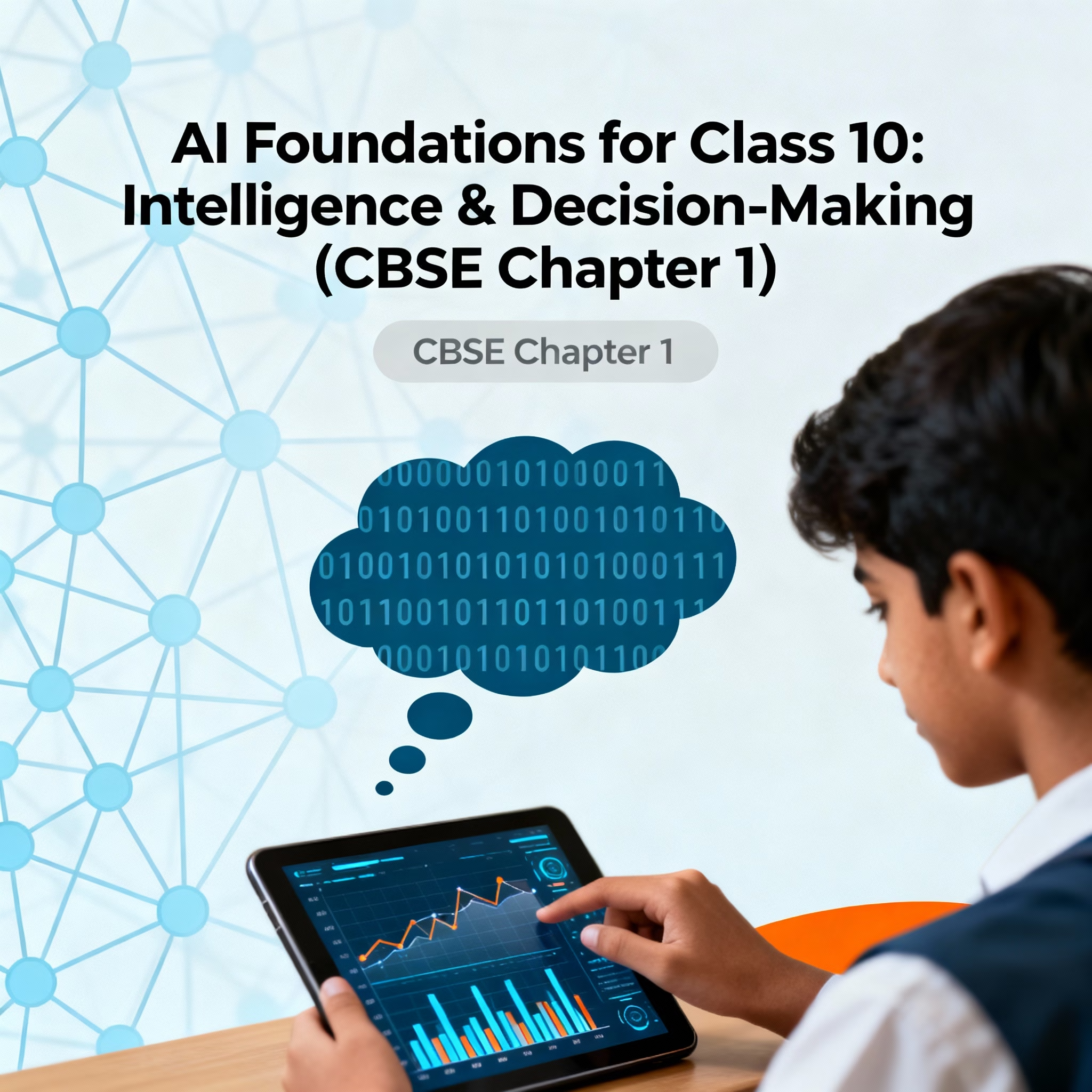
This page covers the basics of human intelligence, decision-making, and how they relate to the core definition of Artificial Intelligence.
1.0 What is Intelligence? Rethinking “Being Smart”
What does it mean to be ‘smart’? We usually think of ‘smart’ people as those who do well on tests. This common idea centers on a single, measurable ability, sometimes called ‘general intelligence.’ This chapter asks you to reconsider that definition. To understand Artificial Intelligence, we first need a better grasp of Natural Intelligence.
1.1 Beyond a Single “IQ”
Psychologist Howard Gardner challenged this old idea in 1983. In his book *Frames of Mind*, he argued for a ‘pluralistic view of intelligence.’ He believed people do not have a fixed amount of ‘smartness.’ Instead, we have many different *kinds* of intelligence.
Gardner defined intelligence as a “biopsychological potential to process information that can be activated in a cultural setting to solve problems or create products that are of value in a culture.”
Let’s break this down:
- “Process information”: Intelligence is how we take in and make sense of the world.
- “Solve problems”: It is a practical tool for overcoming challenges.
- “Create products of value”: This includes writing a poem, building a bridge, or navigating a social situation.
This foundation is important. The official CBSE definition of Artificial Intelligence is a technology that **mimics human intelligence** by performing tasks like “thinking, perceiving, learning, problem solving and decision making.” Therefore, to build AI, we must first identify the human ‘smarts’ we are trying to copy.
1.2 The Many Ways to be Smart
Gardner’s theory names eight distinct intelligences. He argued that everyone possesses all eight, but each person has a unique *profile* of strengths and weaknesses. This “pluralistic” view helps us understand AI.
The AI we use every day, like a chatbot or a navigation app, is not a single, all-knowing ‘general intelligence.’ It is what we call Artificial Narrow Intelligence (ANI), or “Weak AI.”
We can think of today’s AI systems as attempts to copy one or two of Gardner’s multiple intelligences:
- An AI chatbot (like ChatGPT) is an attempt to create Artificial Linguistic Intelligence.
- An AI navigation system in a self-driving car is an attempt to create Artificial Visual-Spatial Intelligence.
1.3 The 8 Types of Human Intelligence
Here is a breakdown of the eight core intelligences identified by Howard Gardner. Use the filters to explore different categories.
| Intelligence Type | Also Known As… | What it is (Simple Definition) | You might be good at… |
|---|---|---|---|
| Linguistic | “Word Smart” | Using words effectively, spoken and written. | Writing stories, debating, explaining ideas. |
| Logical-Mathematical | “Number/Reasoning Smart” | Using logic, discerning patterns, and abstract thought. | Solving puzzles, math problems, coding. |
| Visual-Spatial | “Picture Smart” | Thinking in images, pictures, and 3D space. | Drawing, reading maps, navigating, design. |
| Bodily-Kinesthetic | “Body Smart” | Using your whole body or parts of your body skillfully. | Sports, dancing, acting, building with hands. |
| Musical | “Music Smart” | Producing and appreciating rhythm, pitch, and melody. | Singing, playing instruments, composing music. |
| Interpersonal | “People Smart” | Understanding and interacting effectively with other people. | Teamwork, leadership, teaching, understanding others. |
| Intrapersonal | “Self Smart” | Understanding yourself, your own feelings, values, and goals. | Setting goals, self-assessment, regulating emotions. |
| Naturalist | “Nature Smart” | Recognizing and categorizing patterns in the natural environment. | Identifying plants/animals, farming, biology. |
4.6 Visual Explainer: How AI Learns vs. Automation
This interactive chart shows the key difference between a fixed automation and a learning AI. Use the buttons to change the data.
The dots are data points. The line represents the “rule” the machine follows.
Click a button to see the visualization.
2.0 How Intelligence Solves Problems: The Art of Decision-Making
We’ve seen that ‘solving problems’ is a core part of intelligence. The way we solve problems is by making decisions.
2.1 Why We Can’t Make Decisions Without Information
Decision-making is a basic human skill. It is the process of making a choice. To make a good choice, you need one main thing: information. As the CBSE question bank states, “The basis of decision making depends upon the availability of information and how we experience and understand it.”
If you have no information, you are just guessing. Knowledge or data helps you see the possible outcomes and pick the best one.
Any intelligent agent, human or AI, follows a structured process to make a rational decision:
- Define the Problem: State the decision you need to make.
- Gather Relevant Information: Collect all the facts and data.
- Identify the Alternatives: Brainstorm all possible options.
- Weigh the Evidence: Analyze the pros and cons of each option.
- Choose the Best Alternative: Select the option that best solves the problem.
This 5-step process is a simple version of the professional AI Project Cycle that we will study later. This shows we teach machines to follow the same rational process we use.
2.2 Logic Puzzle 1: The Three Doors Riddle (The Lion’s Lair)
The Challenge:
“You are locked inside a room with 3 doors… Behind the 1st door is a lake with a deadly shark. The 2nd door has a mad psychopath… and the third one has a lion that has not eaten since the last 2 months. Which door would you choose? and Why?”
Solution: Door 3.
Analysis: Doors 1 and 2 present clear danger. The information for Door 3 is different. An intelligent person must *process* this information. Based on biological knowledge (our “database”), a lion cannot survive for two months without food. Therefore, the lion must be dead. This door is the only safe option. This puzzle was solved by applying a logical rule to the provided information.
2.3 Logic Puzzle 2: The Case of the Strawberry Pie
The Challenge:
“Aarti invited four of her friends… two… died… poisoned… in the strawberry pie. The three surviving friends (Shiv, Seema, and Aarti) told the police that they hadn’t eaten the pie.”
- Shiv said, ‘I am allergic to strawberries.’
- Seema said, ‘I am on a diet.’
- Aarti said, ‘I ate too many strawberries while cooking…’
The Key Information: “The policemen looked at the pictures of the party and immediately identified the murderer.” Who was it?
Solution: Seema.
Analysis: The police cannot make a decision based on the alibis alone. Seema’s alibi is weak, but not proof. They need *more information*. This is where the “pictures of the party” come in. The police *gathered new data* (the photos). The logical inference is that the pictures showed Seema eating other “unhealthy” party foods. This new data directly contradicted her alibi that she was “on a diet.” Her alibi was a lie, exposing her as the murderer.
The Core of AI: A Simple Diagram
The two puzzles show that intelligent decision-making needs two things: Data (Information) and Algorithms (Logic). This is exactly how AI works. This diagram shows how these two ingredients combine.
3.0 What is Artificial Intelligence (AI)?
Artificial Intelligence (AI) is a field of computer science that creates systems to simulate human intelligence. The official CBSE curriculum defines it clearly: AI is any technique that “enables computers to mimic human intelligence.”
A machine has AI when it can “make decisions, predict the future, learn and improve on its own.” In short, AI helps a computer “think” and “act” like a human.
3.1 How a Machine Becomes “Intelligent”
How does a machine “learn”? It’s not magic. It uses the same two things from our puzzles: Data and Algorithms.
- Ingredient 1: Data (The “Experience” or “Information”)
A human learns from experience (data). An AI machine learns by being trained with data. This can be millions of pictures, all of Wikipedia, or years of traffic information. This data acts as the “experience” for the machine. - Ingredient 2: Algorithms (The “Logic” or “Recipe”)
An algorithm is simply a set of rules or instructions used to solve a problem. AI uses special statistical algorithms to sift through massive amounts of data to find hidden patterns.
This process of using algorithms to learn patterns from data is called Machine Learning (ML).
ML is the most common and powerful form of AI used today. It is a subset of AI. It gives machines the ability to learn from data and improve at a task without being explicitly programmed for every single step. This is what makes AI different from a normal computer program. A **non-AI program** (like a calculator) follows fixed rules. An **AI program** (like a spam filter) learns the rules from the data.
3.2 AI in Your Daily Life
You use AI dozens of times every day, often without noticing. Here are a few examples.
Example 1: Virtual Assistants (Siri, Google Assistant, Alexa)
These assistants use Natural Language Processing (NLP), a part of AI. NLP is the ability for a machine to understand human language. When you speak to your phone: 1) The AI transcribes your speech to text. 2) The NLP algorithm figures out the *intent* of your command. 3) The AI decides on the correct action and generates a natural-sounding voice to respond.
Example 2: Navigation Apps (Google Maps, Waze)
These apps use Machine Learning to analyze massive, real-time datasets. This data comes from satellites, user-reported incidents, and the location data from millions of other phones. The AI’s job is to: 1) Analyze all this data in real-time. 2) Predict traffic patterns and your estimated time of arrival (ETA). The “fastest route” Google Maps suggests is an AI-driven prediction.
Example 3: Recommendation Engines (Netflix, YouTube, Spotify)
When Netflix suggests a new show, it is an AI system designed to predict what you will enjoy. They primarily use two methods:
- Content-Based Filtering: Recommends items based on their features. “You watched The Dark Knight. The AI tags this as ‘superhero.’ Therefore, it recommends Avengers: Endgame because it shares the ‘superhero’ tag.”
- Collaborative Filtering: Recommends items based on people with similar tastes. “You and Person X both love The Dark Knight. Person X also loved Squid Game. The AI predicts you will also love Squid Game.”
Every time you watch a show or give a “thumbs up,” you are feeding new data to the AI, which updates its predictions about you.
3.3 Image Strip: Real-World AI Examples
Here are more places you can find AI working around you, often hidden in plain sight.
4.0 What is NOT AI? Clearing Up the Confusion
It is important to understand the difference between true AI and other technologies that are often confused with it.
4.1 The Big Misconception
Many devices are “smart,” but this does not make them AI. The key difference, as defined by CBSE, lies in learning and adaptation.
- IoT is the SENSES (Eyes, Ears): IoT devices collect data from the real world (temperature, location, video) and send it.
- AI is the BRAIN: The AI algorithms receive this data and analyze it to find patterns and make intelligent decisions.
Paired Example: A basic smart thermostat is an IoT device because you can control it from your phone. This is IoT + Automation. An AI-powered smart thermostat also uses IoT, but it feeds that data to an **AI algorithm**. The AI learns your family’s usage patterns and autonomously creates a custom schedule to save energy.
4.3 AI vs. Robotics
Robotics: This is a branch of engineering that deals with the design and operation of *physical machines called robots*.
The Key Distinction (Brain vs. Body):
- Robotics is the BODY: A robot is a physical machine that can move and interact with the physical world.
- AI is the BRAIN: AI is software. It is the intelligence that can perceive, reason, and make decisions.
You can have one without the other:
- AI (No Robot): Pure software. Your email spam filter or the Netflix recommendation engine.
- Robot (No AI): A “dumb” robot. A robot arm on a factory assembly line performing automation (a fixed, pre-programmed task).
- AI-Powered Robot: An AI “brain” inside a robot “body.” The most famous example is a self-driving car.
4.5 Table 2: Key Differences: AI vs. The “Other” Tech
| Technology | What is it? (Core Definition) | Simple Analogy | “Dumb” Example (Automation) | “Smart” Example (AI-Enabled) |
|---|---|---|---|---|
| Automation | A system that follows fixed, pre-programmed rules. | A To-Do List | A basic calculator. | An AI chatbot that writes new code. |
| IoT | A network of devices with sensors that collect data. | Senses (Eyes, Ears) | A smart lightbulb you control with your phone. | An AI security camera that identifies intruders. |
| Robotics | Building physical machines (robots) that move. | A Body | A factory arm painting the same car door. | A self-driving car that decides when to turn. |
| AI | A system that learns from data to make decisions. | The Brain | (N/A) | A spam filter that learns to block new spam. |
What’s Next? (Cross-Links)
Now that you have a solid understanding of what AI is (and isn’t), you’re ready to explore related topics. These links will guide you to the next steps in your AI learning journey.
→ AI Basics & History
Explore the different types of AI (Narrow, General, Super) and the key historical milestones that led to the technology we have today.
→ AI Ethics: Bias & Privacy
An important look at the challenges AI creates, including data privacy concerns and how AI models can learn and repeat human biases.
Chapter 1 Resources & Activities
Downloadable Classroom Worksheet
Reinforce your learning with this complete worksheet, which includes multiple-choice questions, short-answer prompts, and a matching activity. Perfect for classroom use or self-study.
Worksheet Preview (MCQs)
1. The ability to recognize and categorize patterns in the natural environment is known as…
- (a) Logical-Mathematical Intelligence
- (b) Naturalist Intelligence
- (c) Visual-Spatial Intelligence
- (d) Bodily-Kinesthetic Intelligence
2. What is the key difference between AI and IoT?
- (a) IoT is software, AI is hardware.
- (b) IoT is for phones, AI is for computers.
- (c) IoT collects data (senses), AI analyzes it (brain).
- (d) There is no difference.
Worksheet Preview (Short Answer)
1. Explain in your own words why a “fully automatic” washing machine is *not* considered AI.
(Hint: Does it learn from mistakes? Or does it follow a fixed program?)
2. Describe the two methods a recommendation engine (like Netflix) uses to suggest a new movie for you.
(Hint: One method looks at the movie’s content, the other looks at other people.)
5.1 Interactive Quiz: Is It AI?
1. A basic calculator used for math homework.
2. Your email service automatically moving a suspicious message to the “Spam” folder.
3. A motion-sensor door at a supermarket that opens when you approach.
4. Netflix or YouTube suggesting a new video for you to watch.
5. A robot arm in a car factory that paints the same car door 1,000 times a day.
5.2 Chapter Notes (Key Takeaways)
- Artificial Intelligence (AI) is a way of making a computer or machine mimic human intelligence. This means it can learn from data, make decisions, and improve on its own.
- Brain vs. Body (AI vs. Robotics): AI is the “Brain” (software, intelligence). Robotics is the “Body” (physical machine, movement). They are separate fields but can be combined.
- Senses vs. Brain (IoT vs. AI): IoT devices are the “Senses” (sensors that collect data). AI is the “Brain” (analyzes the data to make decisions). They work together.
- AI vs. Automation: Automation follows *fixed, pre-programmed rules* (like a calculator). AI *learns from data* and can adapt to new situations (like a spam filter).
- Recommendation Engines use two main methods: Content-Based Filtering (recommends similar items) and Collaborative Filtering (recommends what similar people like).
5.3 Q&A (Test Your Knowledge)
Q1: The ability to understand and interact well with other people, sensing their moods, is called…
(b) Interpersonal Intelligence
Hint: “Inter” means *between* (between people). “Intra” means *within* (within yourself).
Q2: A machine is said to be “artificially intelligent” when it can…
(c) Mimic human traits like learning, adapting, and making decisions.
Hint: AI is not just about being fast (like a calculator) or being connected. It’s about the ability to learn and adapt.
Q3: What are the two main “ingredients” an AI model needs to learn?
(b) Data and Algorithms
Hint: Just like our logic puzzles, AI needs *information* (Data) and a *process* (Algorithm) to solve problems.
Q4: Which of the following is an example of a “Not AI” machine?
(a) A smart washing machine that follows pre-set commands selected by a human.
Hint: This is automation. The machine is just following a fixed program. A self-driving car, spam filter, and face unlock all learn and adapt, making them AI.
5.4 Frequently Asked Questions (FAQs)
Is AI the same as a robot?
No. This is the “Brain vs. Body” confusion. A robot is a physical machine (the “body”). AI is the intelligence (the “brain”). You can have AI without a robot (like Siri) and a robot without AI (like a simple factory arm).
If my “smart” fridge has Wi-Fi, is it AI?
Probably not. If your fridge is just connected to the internet (IoT) so you can get notifications on your phone, that is IoT + Automation. It becomes AI only if it starts learning from data. For example, if it learned your habits, predicted what groceries you need, and automatically created a shopping list, that would be AI.
Is AI “smarter” than humans?
No. The AI we have today is Artificial Narrow Intelligence (ANI). This means it is very, very good at *one specific task* (like playing chess or filtering spam). A human has General Intelligence, which means we can learn and combine all eight of Gardner’s intelligences (Linguistic, Logical, Social, etc.) to solve complex, new problems in the real world. AI cannot do this… yet.