Chapter 2: The Basics of AI
CBSE Class 10 Artificial Intelligence | Updated: October 2025
The modern world uses complex computation. A phone unlocks with facial recognition. A streaming service suggests a movie. A website chatbot answers questions. The technology behind these experiences is Artificial Intelligence (AI).
This page covers the foundational concepts of AI for Chapter 2 of the CBSE Class 10 curriculum. The official curriculum goal is to help students become “AI-Ready”.
Being “AI-Ready” is different from being an “AI-Expert”. The course objectives focus on “appreciating Artificial Intelligence” and understanding AI applications “in our lives”. This approach builds a mindset for *why* AI matters and *how to think about* its use in society.
Learning Outcomes
After finishing this module, you will be able to:
- Define AI using perspectives from groups like NITI Aayog and the World Economic Forum.
- Use a K-W-L-H chart as a tool for tracking your learning.
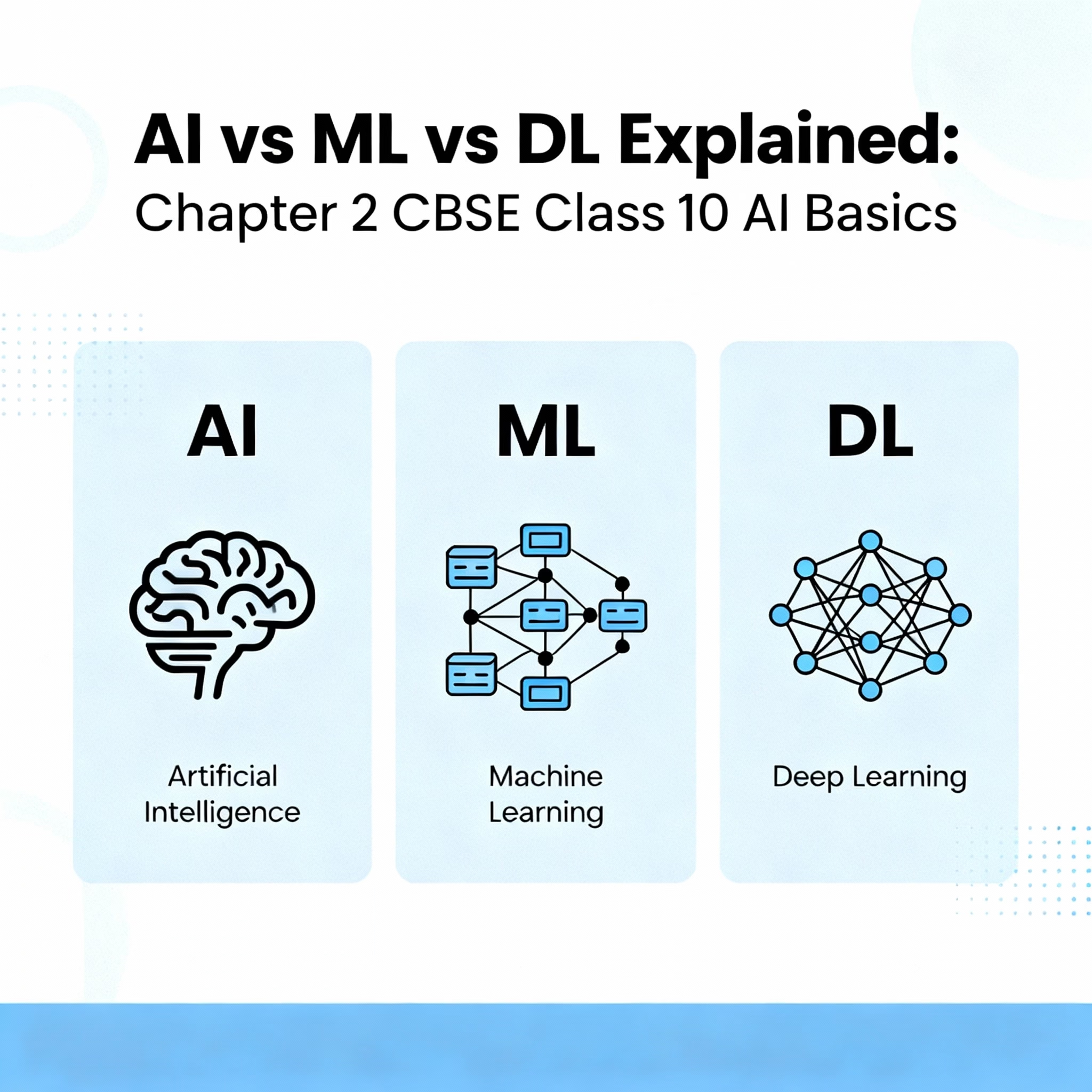
- Explain the differences between Artificial Intelligence (AI), Machine Learning (ML), and Deep Learning (DL).
- Explain *why* ML and DL are subsets of AI.
- Identify the three main domains of AI: Data, Computer Vision, and Natural Language Processing.
What is Artificial Intelligence?
There is no single definition of AI. It is useful to examine definitions from a few sources.
NITI Aayog (India): AI is “the ability of machines to perform cognitive tasks like thinking, perceiving, learning, problem solving and decision making”.
World Economic Forum (WEF): “Broadly speaking, artificial intelligence (AI) is a field of study… characterised by the development and use of machines that are capable of performing tasks that usually would have required human intelligence”.
Encyclopaedia Britannica: “Artificial intelligence (AI) is the ability of a digital computer or computer-controlled robot to perform tasks commonly associated with intelligent beings”.
A simple, consolidated definition is: **Artificial Intelligence is a field of computer science focused on creating systems that perform tasks considered “smart” when done by humans.** These tasks include learning, reasoning, seeing, and understanding language.
AI is Prediction, Not Magic
A common misconception is that AI is equivalent to human intelligence. Kay Firth-Butterfield, Head of AI at the World Economic Forum, clarifies: “AI is not intelligence—it is prediction… it would be a mistake to equate this to human intelligence”.
Current AI systems, known as Artificial Narrow Intelligence (ANI), can only do one task very well at a time. They lack the “common sense” or multi-tasking ability of humans.
AI systems should be viewed as powerful **prediction machines**.
- A self-driving car *predicts* the path of a pedestrian.
- A streaming service *predicts* the movie a user will enjoy.
- A language model *predicts* the most likely next word in a sentence.
This system of learning from data to make statistical predictions is the key to Modern AI. It also forms the logical bridge to understanding Machine Learning.
Activity: Charting The Learning Journey (K-W-L-H)
To build an “AI-Ready” process, this curriculum uses a metacognitive tool: the K-W-L-H Chart. This chart is a graphic organizer for research and self-reflection.
The chart has four columns:
- K – What a student already Knows about AI.
- W – What a student Wants to know.
- H – How the student will find the information.
- L – What the student Learned.
This process of “thinking about thinking” is known as **metacognition**. By using the K-W-L-H chart, students practice a structured process of inquiry.
(Students should fill the ‘K’ and ‘W’ columns now.)
The Big Picture: AI vs. Machine Learning vs. Deep Learning
The terms AI, Machine Learning (ML), and Deep Learning (DL) are often used incorrectly. They are not the same. They are not competing concepts. Their relationship is hierarchical.
The Relationship: Subsets
The relationship is best understood as a set of subsets:
- Deep Learning is a part of Machine Learning.
- Machine Learning is a part of Artificial Intelligence.
- Artificial Intelligence is the entire field.
Interactive: AI/ML/DL Relationship
Defining Each Layer
Artificial Intelligence (AI): The “Big Umbrella”
AI includes the entire field of making machines “smart”. AI can be split into two types:
- Traditional AI (Rule-Based): A human programmer *explicitly* writes rules (“if-then” statements) for every situation. The machine executes the rules. Example: A simple tic-tac-toe game programmed with rules like, “IF opponent has two-in-a-row, THEN block them.”
- Modern AI (Data-Driven): This AI “learns” from data to make decisions. This category is powered by ML and DL. Example: Google Maps learns from real-time traffic data to find the fastest route.
Machine Learning (ML): The “Data-Driven” Subset
ML is a subset of AI defined as giving computers the ability to learn from data without being explicitly programmed. This is a fundamental shift. In Traditional AI, a human writes the rules. In ML, a human provides data and an algorithm. The algorithm studies the data to find patterns and write its own rules. Example: An email spam filter learns from thousands of examples of spam and good emails to identify patterns that predict spam.
Deep Learning (DL): The “Brain-Inspired” Subset
DL is a specialized subset of ML that uses a complex structure called an **Artificial Neural Network (ANN)**. In ML, a human might still need to guide the algorithm by doing “feature extraction” (telling it what features to look for). DL automates this step. It uses deep networks with many layers to learn features on its own. For example, when given an image, the first layer might learn edges, the next layer shapes (like “eye”), and the final layer a “face”. This requires *massive* amounts of training data. Example: A self-driving car identifying a pedestrian from raw camera data.
AI vs. ML vs. DL at a Glance
| Feature | Artificial Intelligence (AI) | Machine Learning (ML) | Deep Learning (DL) |
|---|---|---|---|
| Scope | The broad concept of creating “smart” machines. | A subset of AI. A specific *way* to achieve AI. | A subset of ML. A specific *technique* within ML. |
| Core Idea | A machine that *simulates* human intelligence. | A machine that *learns* from data to make predictions. | A machine that learns complex patterns using an *Artificial Neural Network*. |
| How it Works | Can be “Rule-Based” (explicit “if-then” rules). | Uses statistical algorithms to learn from *structured data*. | Uses deep neural networks to learn from *raw data*. |
| Human’s Job | (Rule-Based): Write *all* the rules. | Provide data, select algorithm, do “feature extraction.” | Provide *massive* data, design network. Network does feature extraction. |
| Data Needs | Varies. Rule-based AI needs *no* training data. | Requires data. Works well with small to medium datasets. | Requires *massive* data. Performance improves with more data. |
| Example | A chess bot with pre-programmed moves. | Netflix’s recommendation engine. | A self-driving car “seeing” a stop sign. |
Activity: Where does it belong?
Drag each example into the **most specific** circle it belongs to. A self-driving car uses AI and ML, but its *core technology* is DL, so it belongs in the ‘DL’ circle.
Drag from here:
Drop here:
Overview of AI Domains (CBSE Class 10)
AI is a vast field. The CBSE curriculum simplifies it into **three main domains** based on the *type of information* the AI processes. These three domains form the core of the AI-specific units.
Domain 1: Data (Data Science)
This AI domain “thinks” using **numbers, text, and data tables.** It finds hidden patterns and makes predictions from data.
Where it is seen:
- Streaming service recommendations.
- Bank fraud detection.
- Business sales predictions.
Domain 2: Computer Vision (CV)
This AI domain allows machines to “see” and understand the world through **images and videos**.
Where it is seen:
- FaceID on mobile phones.
- Auto-tagging friends in photos.
- Autonomous vehicles identifying signs.
Domain 3: Natural Language (NLP)
This AI domain gives machines the ability to understand and generate **human language** (spoken or text).
Where it is seen:
- Siri, Alexa, and Google Assistant.
- Google Translate.
- Customer service chatbots.
Completing the K-W-L-H Chart
This module established the foundational knowledge for AI. It defined AI as a field of “prediction machines,” not “thinking machines,” and clarified the relationship between AI, ML, and DL.
Key Takeaways
- AI (Artificial Intelligence) is the broad, “umbrella” field of creating smart machines.
- ML (Machine Learning) is a *subset* of AI that *learns from data* to make predictions.
- DL (Deep Learning) is a *subset* of ML that uses *brain-inspired neural networks* to solve complex tasks.
- The three main AI domains are Data (Data Science), Computer Vision (CV), and Natural Language Processing (NLP).
As a final step, students should return to their K-W-L-H chart. It is time to fill in the most important column: **’L’ — What I Learned.**
This final reflection reinforces the new knowledge. Students should review their ‘W’ (Want to Know) column to see if their questions were answered. This process encourages new questions and builds the curiosity that defines a student as “AI-Ready.”
Continue Your Learning
Now that you understand the basics, explore the next key topics in the curriculum. These modules build directly on what you’ve learned.
Next Up: AI Domains
Take a deeper look at Data Science, Computer Vision, and Natural Language Processing. Explore real-world projects in each domain.
Go to Domains →Deep Dive: Neural Networks
Understand the technology that powers Deep Learning. Learn how ANNs are inspired by the human brain and how they “learn” from data.
Explore Neural Networks →